As a composer, are you inspired by other art forms? If so which ones?
I’m definitely inspired by visual elements; in my understanding they correlate almost directly to music: colour, line, thickness, shape and position/structure, texture, and depth of field. All of these things are musical concepts as well as visual ones – and, for me at least, more tangible as elements of communication when working in the studio environment.
For example, you might choose to compose a musical idea and orchestrate it for woodwinds because you know it will communicate a certain texture and imbue the music with flavour, and you’re aware that that choice brings with it emotive associations and cultural clichés; but beyond that choice and the notes/directions you give the performer, you cannot control the ambient performance environment or the proximity of the listener to the sound source. The variances in instrument build and playing technique could change the timbre in ways you didn’t expect. For this reason I see the composer in the studio production context as having the ultimate control – and like a visual artist, producing a definitive version of an artwork (in this case a recording). In the studio you can influence, control and change a performance; you can dial up the perfect EQ curve/colour, you can position the sound in the 3D listening space and give your composition depth of field. So, in the studio at least, there is definitely a very strong visual correlation and I’m definitely inspired by the potential there.
Leah Kardos (Photo by Matt-Roles)
Do you use a computer for your work? When did you start?
Oh yes! I’d feel very lost if I didn’t have access to a computer to make music. Currently, I use Logic Pro as my go-to application for composition (rewired to Sibelius for scoring), but also occasionally Ableton Live, Reason 5, Cycling 74’s ‘M’, and countless plug-ins and virtual instruments to get the job done.
I started using a computer to make music when I was studying my BMus Degree at UQ. My composition professor showed me how to use Sibelius – it was revolutionary! Soon after that I signed up for modules in record production and learned how to operate the recording studio. This would have been in 1998/9 and the recording set up was still using tape machines, but there was a computer in there running Cubase VST. I will never forget what that little machine represented to us at that time – limitless possibilities. I remember thinking it was a miracle, and to this day I feel that way about my computers.
I use it at every stage of my creative processes: from capturing improvisations as MIDI data, to scoring, realising, experimenting, mixing, mastering and remixing/deconstructing. The computer is many things to me: a scribe, an organiser, a memory, a pseudo ensemble of players, a calculator of permutations, and sometimes an expressive instrument in and of itself.
Do you still use paper? What for?
I carry a little moleskine manuscript with me wherever I go and I use it to jot down ideas (which always seem to hit me at the most random and inopportune times). I also have a big orchestral score pad that lives on my piano stand. I used to spend time drawing dots on the pages, but these days it’s more scribbles, drawings and chord symbols.
Sometimes, just for a change, I’ll sit down at the piano and compose straight to score – the thought processes involved in that, and the decision-making that goes on in between the notes, is different to when I’m sequencing in Logic or writing in Sibelius. It’s useful, and I probably don’t do it often enough.
Does working on a computer affect the way you compose?
It definitely influences decision-making. Things like having an Edit > Undo option, or saving multiple versions of a composition – for me these options allow me some freedom to explore tangents and experiment with the raw materials.
Working with recording software has also given me a greater appreciation for the timbral and psychoacoustic properties of sound, and how they can be used to communicate ideas and feelings in a musical composition: these elements being historically outside of the composer’s complete control up until relatively recently. Sound design is a big thing for me, something that is potentially very expressive. The sound and instrument plugins getting around these days are amazing – a constant source of inspiration. At the moment I’m particularly obsessed with the stuff being made by the people at Tonehammer. They’ll make a playable expressive instrument out of anything – bees buzzing, footsteps in snow, the hum of a fluorescent light and so on. Brilliant.
Are you concerned with a possible loss of craftsmanship because of technology?
Sometimes I get a little dismayed when a new tech application comes out that makes short work of something that I studied hard to learn how to do the long way. It happens all the time, but a recent example is the Izotope Stutter Edit plug in that came out last month – it’s wonderful and yes it saves me loads of time, but it makes some of my education and hard-won skill set redundant. I used to be quite good at that sort of fine audio editing; now everyone can do it easily. It’s just the nature of technology, so you have to embrace it. The way I see it, good ideas will speak regardless of the tools used to create them. The composer/producer’s job is to make and implement creative choices based on their unique musical intuition – it’s my view that technology is just a tool to quicken that process.
Leah Kardos is a composer, producer, arranger, pianist, PhD student and music tech lecturer working in Bedford, England. Her work explores the unique opportunities for creativity that arise when working with technology applications, in contexts including live performance, studio production and film scoring. Of particular interest is manipulating recorded performances of score-based compositions to create completely new and vastly different works, focusing on timbral/textural elements and the use of production techniques to exploit psychoacoustic effects. http://www.leahkardos.com
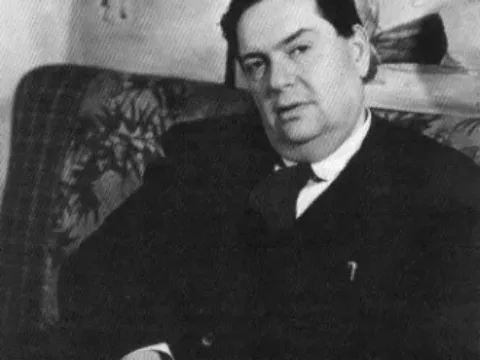
This week’s composer is another member of Les Six: Darius Milhaud.
Darius Milhaud (1892-1974)
I remember, as a teenager, being puzzled by the spelling of his last name: the -lh- combination is very rare in French and somehow reminiscent of Brazilian spelling (did he have to compose his Saudades do Brasil (1920-1921) to confuse me even more?!). Anyway. His last name is really easy to pronounce for American English speakers: ME-Yo!
Audio clip: Adobe Flash Player (version 9 or above) is required to play this audio clip. Download the latest version here. You also need to have JavaScript enabled in your browser.
Here is a video of Milhaud’s Sonata for 2 violins and piano, Op.15 (excerpt) by Angela and Jennifer Chun.
Angela & Jennifer Chun perform Sonatina for Two Violins by Darius Milhaud
Did you know that Milhaud had Philip Glass and Steve Reich as students? Was then American Minimalism influenced by Les Six?!? Just kidding… What is your favorite Milhaud piece?
Was this helpful? Is there any other name (composer, piece, instrument, etc.) that you would like to see on these pages? Just post a comment or find me on Twitter: @tonalfreak.
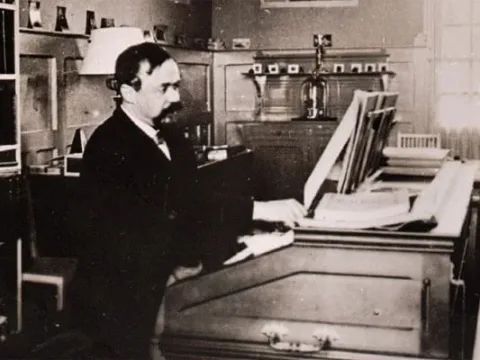
This week’s composer was also known as a music critic, and orchestrator (for Saint-Saëns for instance): Paul Dukas.
Paul Dukas (1865-1935)
The [u] in Dukas is, once again, the most probable difficulty in the pronunciation. Remember that in order to pronounce a nice French [u], one has to protrude one’s lips, and pronounce an [ee] sound…
The other source of confusion is the final S. Indeed, very few final consonants are pronounced in French (only the ones followed by an e—and hence not really final anymore!—usually are). Some say that the S is pronounced in Dukas, some say not. I’ve heard both, even among native French music lovers. This article from a BBC blog sates that “Dukas, is in fact pronounced due-KASS, and not due-KAA. This pronunciation was passed on to the pronunciation unit in 1955 by a friend of the Dukas family, who assured us that this was the composer’s own pronunciation.“
So following this last tip, here it is:
Audio clip: Adobe Flash Player (version 9 or above) is required to play this audio clip. Download the latest version here. You also need to have JavaScript enabled in your browser.
Was this helpful? Is there any other name (composer, piece, instrument, etc.) that you would like to see on these pages? Just post a comment or find me on Twitter: @tonalfreak.
Next chapter in my epic(!) series documenting the writing of my Master’s thesis: a secular cantata.
The (cr*ppy) desk
I have finalized the texts and the piece is completely outlined. The thing that I am most excited about is probably the last text that I (painfully) finished (any librettist reading this email? Let’s work together!) yesterday. I have been experiencing with text algorithms to generate Spoetry, a recent form of poetry that uses spam messages subject lines as a textual source. I’ve achieved some interesting results, but wasn’t really satisfied until I found a brag generator. In this movement, I’m trying to illustrate the current hubris that is a direct consequence of the empowerment and self-entitlement brought by technology. The text that I crafted from these randomly generated, obnoxious statements is really satisfying :) And quite funny too. Here are a few lines:
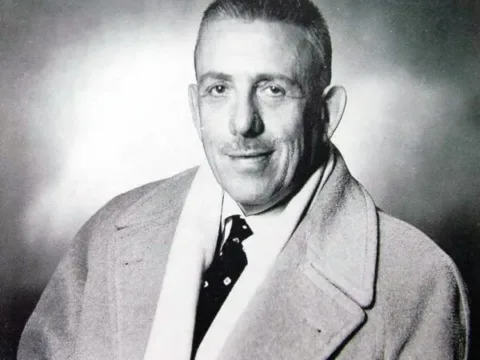
This week’s composer was part of Les Six, this group of young Parisian composers that were probably brought together by Cocteau in the early 1920s, and whose aesthetics came in reaction to Wagner’s influence and impressionistic music: Francis Poulenc.
Francis Poulenc (1899-1963)
The only difficulty in this name is the pronunciation of the nasal in -en, which is usually pronounced as an ã, a nasal a as I like to refer to them, as in blanc, white. But no, here this nasal is pronounced with an i nasal, as in vin for wine. Combined with the unusually pronounced final c (a strong K sound), Poulenc will rhyme with cinq, French for 5 (weird for a member of Les Six !) Alright, here it is:
Audio clip: Adobe Flash Player (version 9 or above) is required to play this audio clip. Download the latest version here. You also need to have JavaScript enabled in your browser.
Of course, this is just a suggestion. Winston Churchill was quite right when he said: “Everybody has a right to pronounce foreign names as he chooses.”
Before I let you go, here is a fantastic video of Poulenc himself (left) playing his Two-Piano concerto (with Jacques Février, right), under the baton of a young Georges Prêtre.:
What is the importance of music in your work? Are you inspired by musical concepts such as rhythm, counterpoint, dynamics, etc.?
Music has a small part in my life. I think that I could live without it. Electronica irritates me and instrumental music almost only moves me when it is associated with visual memories—a movie soundtrack, for instance. Rock or indie pop keeps me company in my car, or at home as a background while I go about my business—I never sit in a chair in order to listen to music but I can be moved by singing, by a voice with a particular timbre, or frailty, by its humanity. Pure music, non-vocal, is too disincarnate to touch me. It certainly never inspired me.
Do you use a computer for your work? If so when did you start?
I turned on a computer the day I started working, and immediately scrapped my drawing table. Precision ink pens are but a remote memory from school. In my professional life, if I’m not on a construction site, I’m sitting in front of my screen.
Recent project: art gallery and swimming pool by Ariane Delacre
Do you still use paper, and if so what for?
In the conception phase, I still use paper. Ideas come to life through the gesture of the hand and the line of the pencil, sometimes in an unconscious way. The keyboard or the mouse prevent this transmission. But these are nasty sketches that are only relevant to me and that are never shown to a client—I am too bad at drawing for that!
Has working on a computer affected the way you think about architecture?
The image of architecture changed with the arrival of computers. We are not scatterbrained creatives anymore, who break their backs and ruin their eyes on their drawing tables for nights on end, cloistered in their dusty workshop. We work, like anybody else, in an office equipped with a computer, a printer, and a phone. The image lost its romantic touch. To me, computer science hasn’t changed the job, it is only a very convenient tool that I couldn’t do without anymore. The projects that I design could still be drawn by hand, if time weren’t an issue. I don’t need CAD softwares, Autocad and Sketchup are amply enough for me. I like lines and right angles, their timeless character; complex and impossible-to-compute curves don’t attract me.
Recent project: art gallery and swimming pool by Ariane Delacre
Are you concerned with a possible loss of craftsmanship because of CAD (Computer Assisted Design)?
Architecture draftsmen now only work in huge studios, whereas they used to be present in mostly every workshop in the past: a workforce was needed to draw, ink, scratch, and re-draw endlessly on pieces of tracing paper that always ended ripped. These “petites mains” (helping hands) have practically disappeared, but many of them have successfully switched to 3D imaging, increasingly requested by clients that desire a virtual model, or by competition officials that are seduced by these representations, more beautiful and shinier than reality. Computer science enables me to work alone because drawing and writing documents became faster. If I had to draw or write by hand, the time I would be spending wouldn’t make my business profitable anymore.
Born in 1976 in Charleroi (Belgium), Ariane Delacre graduated from architecture school in Brussels in 1999. Ariane lived and worked in Venezuela, Barbados, Italy, and Spain before opening her own studio in Brussels in 2008: http://www.arianedelacre.be