Archives for March, 2011
Posted by Thomas Deneuville »
1 Comment »Are you inspired by other art forms? If so, which ones?
I take inspiration in an indirect way from everything, not just the arts. Even as I’m writing this I’m looking at the mosaic table at the coffee shop I’m at and the hills across the street, listening to the conversations around me and the traffic going by. Absolutely anything, or absolutely nothing, can be a specific inspiration for the music I write, but that music ultimately comes from me, and who I am is shaped by everything I experience, all the time.
That sounds nearly absurdly metaphysical, so here’s a more practical answer: yes, and especially painting and film. When I’ve got to deal with proportion and balance in a piece, I think about paintings that have struck me and how they’re constructed. And the qualities I appreciate in film I also appreciate in music…not only that something is well-crafted and deep and complex, but also that it grabs your attention on the surface. The best films are the ones that are simultaneously deep and meaningful and wildly entertaining, and I think the same can be said of the best music.
Do you use a computer for your work? When did you start?
Yes, but how much depends on the work. If I’m writing something electronic then I use it for everything. For acoustic instruments I’ll usually just use it for making the score and parts. With rock music I’ll use it for some arranging too. I’ve been doing it that way about as long as I can remember.

Nick Norton
Do you still use paper? What for?
Yes, lots. I sketch on paper, sometimes shapes and lines without pitches. When I use pitch sets I’ll figure out all the ways to transform them on paper. Usually when I begin to come up with some music I’ll write it on paper first, and write a few different versions of it down. That way I can compare them just by looking at them, or see how they can fit together. A lot of them time when I’m writing on an instrument, like my guitar or piano, it’s easier to just have a piece of paper there than to go back and forth to the screen.
Does working on a computer affect the way you compose?
Well it makes my scores legible! Sometimes I’ll get new ideas while listening to the playback of a MIDI realization, so I suppose it does, but I don’t see working on it as integral to my composing, or it having a really drastic effect. Unless, of course, I’m writing electronic music or working with loops.
Audio clip: Adobe Flash Player (version 9 or above) is required to play this audio clip. Download the latest version here. You also need to have JavaScript enabled in your browser.
Link to the MP3 – String Quartet No. 1: London: 3rd movement
Are you concerned with a possible loss of craftsmanship because of technology?
Not really, actually. There will always be people who head to conservatories and practice twelve hours a day to get amazing technical facility, and there will always be people who throw notes around and cross their fingers. Perhaps we’ll begin to see a new kind of craftsmanship in the form of technological literacy and efficiency. And there’s definitely a lot of craftsmanship and artistry to sound design and working with effects. Especially guitar pedals!
For my money, though, good music is good music, and beyond intellectual curiosity and a hope to add to my own abilities, I don’t particularly care how it’s made.
Nick Norton is a 24 year old composer and guitarist from Los Angeles. He grew up playing in punk bands but loves to write concert music of all types. http://www.nickwritesmusic.com
Posted by Thomas Deneuville »
2 Comments »This afternoon in TriBeCa, the Flea Theatre was hosting the Open Salon, part of the Music With a View festival, curated by the extraordinary Kathleen Supové. Three hours of New Music, in the format of a 19th century salon, with a nice person (here James Moore), welcoming the composers+performers, introducing the pieces. There was a lot of great music, and I will only mention a few people, in no particular order.
Jeremiah Bornfield was premiering two pieces: an Homage to Philip Glass for solo violin performed by Mary Rowell, and an art song performed by soprano Lauren Alfano (text and music Bornfield).

The violin piece was an improvisatory/minimal piece emulating/transcending Mr Glass’s musical idiom (IC 3 and 4 anybody?) in real time, while the art song was an ambiguous testimony of a (dead?) woman in limbo—or was it a dream?
Ryan Homsey was presenting a nice duet for violins, that he prefaced as a reference to his past career as a professional ballet dancer, and the relationship between two dance partners. I enjoyed the intertwined violin lines, the exchanges, each musician accompanying the other in turn, and the performers facing each other, their profile to the audience. I would like to hear this piece again.

Rob Dietz and Phyllis Chen painted an vivid sonic tapestry sitting on the floor and interacting with a MacBook through game controllers. It was interesting, but I wish that what was going on on their screen had actually been projected for us to see… I felt kind of “excluded” by the “staging” of the piece.

An refreshing duo: Daniel Foose on bass, and Sueyoung Yoo on piano and voice, played Tahrir Square (Foose’s original composition), Gloomy Sunday (a song composed by Hungarian pianist and composer Rezső Seress) arranged by Yoo, and an excerpt from Pansori Chunhyangga, also arranged by Yoo. A Pansori is a traditional form in Korean music, usually only intended for percussion and voice. Yoo’s arrangement was compelling and her vocal inflections really engaging.

Roy Vanegas, also known as Noise Floor Music, was also presenting two pieces today: Free for flute and cello, and The Dedication, for piano 4 hands. Free presented an intricate counterpoint between the flute line and the cello pizzes leading to a more lyrical section featuring rhythms usually found in downtempo electronica (a Noise Floor Music trademark :) ). The Dedication was more minimal in its texture even though if the rhythm could sometimes get complex, in a long chain of syncopations.
Ryan Manchester was presenting Echoes of Light, a solo percussion piece written for Melanie Sehman (who performed beautifully tonight). The piece is inspired by the “light echo observed as star V838 Monocerotis formed into a red supergiant” (more info on his blog). Indeed, the metallic echoes, waves of gongs, and bowed notes on the vibraphone created a timbral universe that took us far from the noisy streets of downtown Manhattan. Check the recording on his website.

Neil Prufer performed a post-romantic (?) solo piano piece flirting with atonality—sometimes outlining a row. I enjoyed the narrative and the dramatic content and would love to hear more music from this former student of Louis Karchin
Cornelius Duffalo was performing a piece composed by Armandao Bayolo for solo violin and live electronics. As much as I really enjoyed the melodic material, the general pulse, and the slower, introspective middle section, I was really not into the loop pedal (among others) that Duffalo used. He is (and I don’t think that anybody would say otherwise) an incredible musician but I almost wanted him to leave the pedals alone to just play his violin. As an audience member, I was drawn into the technicalities of this kind of effects and didn’t enjoy it.

Finally, Daniel Felsenfeld presented a very beautiful, clever, funny and challenging piece in the form of variations on stuff he hates. Performed by Blair McMillan, Felsenfeld used musical material of very low value (my words, not his) to fire up his imagination. The result was an exciting piece, activating all the registers of the piano. He will also be leading hosting a discussion about the state of the arts and music at the Flea (along with Ian Moss and Peter Catapano) on Wed. March 30th at 6pm. Don’t miss it, because I will :(
Oh, and Walter Aparicio performed Phototactic, a piece of mine for solo piano. It can be heard here on my Music page…
Were you there? Did I misspell, or forget you name? Would you like to mention other pieces you enjoyed—or not? Feel free to leave a comment in the section below or find me on Twitter: @tonalfreak.
Posted by Thomas Deneuville »
1 Comment »As a composer, are you inspired by other art forms? If so which ones?
I’m inspired a great deal by other art forms. In my undergrad at Hartt, I used to log in as many hours at the Wadsworth Atheneum as I did in the concert hall. A particularly inspirational piece for me was Rauschenberg’s Retroactive I, which got me to start experimenting with fragmentation and “found” musical ideas. Lately, I’ve been revisiting Klimt and Schiele’s work, having tied in with a piece I wrote for wind ensemble and electronics, TWEAK.
Do you use a computer for your work? When did you start?
I have a love/hate relationship with computers and music making. I use a computer for notation and the like, but haven’t really been able to get over the hump toward using electronics as a medium until very recently, maybe only three years ago. That said, I believe that I was in the wrong in my attitude that a composer could ignore the influence of computer technology in composition. Considering how ubiquitous computers are in our society (this is a blog interview, right?), how could they not affect the art that we make?

J. M. Gerraughty
Do you still use paper? What for?
I do still use paper and pencil (I bought a fancy pencil and named it Excalibur. Dont’ laugh, it’s a nice pencil!), but mostly for sketches and scratch scores. I don’t intend for people to look at my manuscripts, so I don’t keep track of them or anything. Even if people saw them, they’re mostly scribbles anyway. My process is to sketch on paper, then put my finished ideas into Finale.
Does working on a computer affect the way you compose?
I think that working with a computer affects the way we compose, for certain. I recently took an interview for a PhD program, and one of the first questions out of their mouths was “do you use the Playback Button?” I think it’s interesting that so much scandal surrounds this feature of notation software. As for using other programs, I definitely think that the way you make music with electronic software is much more akin to the process of creating visual art than traditional notation. There’s a lot more “play” involved, and a lot more experimentation, which is freeing, but can make you feel vulnerable. I find that MAX/MSP and similar programs really push the boundaries of music in many exciting directions, which I’m just beginning to explore.
Audio clip: Adobe Flash Player (version 9 or above) is required to play this audio clip. Download the latest version here. You also need to have JavaScript enabled in your browser.
Link to MP3 – J. M. Gerraughty – Slant of light
Are you concerned with a possible loss of craftsmanship because of technology?
With the advent of digital photography, there came a backlash. Older photographers hated the idea: it vastly democratized an already very democratic medium of photography, allowing many with no training at all to pick up a camera and start taking pictures. It undermined their years of darkroom experience. People didn’t have to concentrate on the shot as much because if they messed up, they could see it in the viewscreen and simply retake the shot. It watered down the public’s desire for high-quality film photography which digital photography still can’t match to this day. Still, more pro photographers use digital cameras today than film, even though they know that film is better.
“Craft” is an idea we use to make ourselves feel like we’ve earned some kind of legitimacy through years of study, that making art is somehow not as random and intuitive and inexplicable as we know it to be. Craft helps, but it’s not something I’m worried about losing when I choose to make my life a little bit easier.
J. M. Gerraughty (born 1982) in Nashua, NH, is a composer based out of Stony Brook, NY. His current projects include works for Johns Hopkins University and for hornist Lydia Van Dreel. He struggles with the piano every day. http://www.jmgerraughty.com
Posted by Thomas Deneuville »
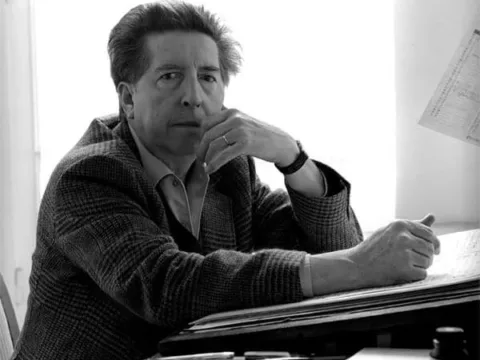
1 Comment »This week’s composer is Henri Dutilleux, a living (as of today) French composer whose work is often said to be in the tradition of Ravel, Debussy, or even Roussel. A kind of a free thinker, I rather like what he said about the dark years that followed WWII: “What I reject is the dogma and the authoritarianism which manifested themselves in that period.”

Pronunciation wise, the challenging element (apart from the French u see Murail) is probably the semivowel -lleux. It is pronounced as a glide, as if you were trying to say “yuh” in English. Here it is:
Audio clip: Adobe Flash Player (version 9 or above) is required to play this audio clip. Download the latest version here. You also need to have JavaScript enabled in your browser.
Link to MP3: ICIYL – Henri Dutilleux
I leave you with his Blackbird (1950), one of a few chamber pieces he wrote, performed by Anne Queffélec.
Was this helpful? Is there any other name (composer, piece, instrument, etc.) that you would like to see on these pages? Just post a comment or find me on Twitter: @tonalfreak.
Posted by Thomas Deneuville »
1 Comment »As an artist/designer, are you inspired by other art forms? If so which ones?
Music is definitely my big inspiration, especially soulful house music. I love to look at anything that pushes the visual and conceptual boundaries of what is accepted or has been done, which includes photography, illustration, architecture and largely graphic design.

Boris Pelcer
Do you use a computer for your work? When did you start?
I do use computer for my work and its usually there to quicken my process. I started using computer for art when I was 7, and of course that was for fun. I loved using Paint to draw Sonic the Hedgehog. However, I really got into into Photoshop in the junior year of high school.
Do you still use paper? What for?
I start all of my ideas on paper. The gestures I can capture with the use of paper and pencil is nothing that I can capture on computer even with the use of my tablet.

Does working on a computer affect the way you create?
The results are much cleaner and it does not allow for the same gestural results as with the hand done drawings. Hence, that is why I start out everything on paper, and computer is there to clean it up for the final version.
Are you concerned with a possible loss of craftsmanship because of technology?
A lot of people may get absorbed by the technology use and forget the value of hand done art work. However I am certain many like myself will still continue to do everything by hand first and use technology as a tool to finalize a product into a digital format. In doing such I can capture the hand crafted look and use the power of technology to do it quickly, and with the power of Internet I communicate with my clients faster and market my work just as effectively. In addition those that continue to value and apply hand crafted art will certainly stand out.
Born in 1985 in Bosnia and Herzegovina, Sarajevo, I moved to U.S.A. in 1998 in search of better life. I recieved my B.F.A. in Illustration from Milwaukee Institute of Art & Design. Since I have worked as a freelance Designer/Illustrator, and full time Apparel Graphic Designer where I had the opportunity to work with great clients such as Urban Outfitters, Spencer’s, Zumiez, Hot Topic, Harley Davidson, Miller Brewing Co., Target & Kohl’s. I have also been awarded by SOCIETY OF ILLUSTRATORS and had work published in publications such as CMYK. Currently I am working on my MFA in Graphic Design and using that opportunity to push the boundries between Graphic Design, Typography & Illustration and merge the different disciplines closer together for innovative methods of visual expression. http://www.borispelcer.com
Posted by Thomas Deneuville »
Add Comment »If you love books, you might be concerned (or not—discuss…) about their future. Some people say that we are living in an age called the End of Print. In August 2010, Nicholas Negroponte (founder and Chairman Emeritus of Massachusetts Institute of Technology’s Media Lab) even predicted the death of the physical book in 2015…
In this context, I was surprised to read that a new service called Yearly Leaf offers to print a year of your Facebook wall, updates, pictures, etc. for a reasonable (? I couldn’t find it anywhere…) price. The books are bound in Moleskine cover.

I can already see slick pictures of coffee tables on Ffffound! exhibiting a pile of Facebook years: 2009, 2010, 2011… I am quite surprised by this new product since I really didn’t expect a new print product to emerge from Social Media.

I was already puzzled by Tweet Rings, a service that offer to print your favorite tweet on a ring, but this move back to paper is really unprecedented in Social Media (have you heard of anything similar?). Can one expect more services of this kind? Maybe for Tumblr? Or maybe to turn one’s blog into a book? Wait, that has already been done too… Well, what else have I missed?!
Would you buy one? Have you put enough personal information on Facebook to turn your printed wall into a piece of memorabilia? Is this a new way of scrapbooking?
Feel free to post a comment or find me on Twitter: @tonalfreak.