Archives for April, 2011
Posted by Thomas Deneuville »
Add Comment »Two weeks ago I was in Solomons, MD (my girlfriend had an art opening for a group show of portraits) where I met Katherine Knight, a Washington DC based painter. We started talking about craft and technology and she had to be interviewed on these pages…
During our conversation you mentioned using your iPhone in your creative process/practice. Can you tell me how? Do you consider getting an iPad?
It’s becoming a cliché, but I would say that my iPhone has completely changed my life; particularly the way I conduct research for my studio. Prior to the iPhone, my research tools consisted of my digital camera for taking reference photos, a sketchbook for studies and compositional ideas, my computer for internet research and Photoshop (which I’d use to compose some of the more complicated paintings), a Wacom tablet and drawing stylus, color media (watercolor, gouache, or acrylic paint) for color studies, and various different types of paper for specific tasks. Now I can do all of that on my iPhone. I’ve given up a little in quality- the camera is not as good, and the drawings are a bit clumsy, but it’s certainly sufficient for research, and I’ve gained so much in flexibility. Plus I think the technology is only going to improve. I don’t have to carry as much stuff around with me anymore, and I spend a lot less time at my desk. Before, I would have to consciously put on my Artist Hat. I’d have to think ‘I’m going to the zoo today, better take the camera in case I see something I want to use’. The iPhone is with me all the time, and allows me to easily take my research with me wherever I go, without forethought. I never used to be one of those artists doing sketches all the time out in public. What interests me most is color, and it’s quite a hassle (and sometimes prohibitively messy) to carry color media around with you- even if it’s only colored pencils. The very first thing I did with my iPhone was download a drawing app (ArtStudio), and now I can do color studies absolutely anywhere. I’ve drawn on the Metro between stops, in the car on road-trips, in class while my students are working, even at night in the dark. I can work in full color in museums, directly in front of the paintings- it’s amazing. I’m becoming much more fluent with color, which is helpful when I’m back in front of my easel.

As for the iPad, I caved! My husband and I just bought one to share (which is difficult, but we’re managing). It is a MUCH more advanced machine, and having the bigger screen makes it much easier to work with. But because of its size it’s still not quite as spontaneous as the iPhone. I’m looking forward to having it in class, in museums, and on trips. Ultimately I think it will be nice to have both.


[Read more →]
Posted by Thomas Deneuville »
2 Comments »This Wednesday, the French Institute Alliance Francause (FIAF) presented a concert featuring French stars of Young Concert Artists (YCA). In over 50 season, the YCA, founded by Susan Wadsworth, has helped emerging artists to launch their careers. Former price laureates include Dawn Upshaw, Jean-Yves Thibaudet, Emmanuel Ax, etc.
Pianist Jean-Efflam Bavouzet and the Modigliani Quartet were sharing the bill tonight. A laureate of YCA back in 1986, Bavouzet was just back from a north American tour while the Quartet will be heard in Australia and Japan later this year.
The Modogliani opened with Haydn’s quartet in B-Flat Major, Op. 76 No. 4 (“Sunrise”). The four (very) young men (Philippe Bernhard, Loïc Rio, Laurent Marfaing, and François Kieffer) revealed, with great delight, the warm colors of the Allegro con spirito. The sound was rich and balanced (especially during the imitative section of the Finale). The Adagio showed that they were as comfortable in slow tempi, and their sober lyricism finished to convince the audience that they are not a young sensation, but an already mature formation. I would love to hear them in a more recent repertoire (a Glass quartet? Different Trains?).

[Read more →]
Posted by Thomas Deneuville »
Add Comment »As a composer, are you inspired by other art forms? If so which ones?
For sure I’m inspired by other art forms and design, craft, etc. Art is all one ongoing conversation, and one form answering another is integral. Literature included. Good writing always inspires me (as does good cooking. Is that art?) Paintings, and often the buildings that house them, inspire me – I’m a sucker for the Impressionists. Now and then I’m moved by photography. I’m less musically inspired by sculpture, so far. Once I witnessed a four year old dancing alone, slowly and freely with great purpose, in complete silence. It was a bewildering example of movement as art, and was very inspiring to those of us who were lucky enough to catch it.
Do you use a computer for your work? When did you start?
Yes I use a computer for my work. I started writing on paper just before software and hardware were developed to a useable and somewhat reliable level. The programs at first were very frustrating, but I was hooked anyway. Then by about ten years ago, I was sketching on paper downstairs and then running upstairs to the computer. It kept me fit. Now I am mostly on the computer. A desktop with bells and whistles for sequenced music, and a barebones laptop when writing for human players and singers that I can plunk on a desk or a piano or at a ski lodge.

[Read more →]
Posted by Thomas Deneuville »
1 Comment »Two years ago, the first time I went to Music with a View in TriBeCa, Geoffrey Burleson (with whom I was lucky to study piano) and Mary Rowell performed a Marc Mellits piece called Spin. I immediately really loved the piece and wanted to know more about it, buy the CD, the score, the mug, etc. Naturally I went to Mellits’s website and started looking for a recording of the piece. What did I find? An excerpt.
Just an excerpt.
I went straigt to Amazon MP3. Nothing. iTunes? Nothing. YouTube? Nothing. Bummer. What was I supposed to do?
I contacted Dacia Music, the company that publishes his music, and got a copy of the score, that I can now follow along the 3 minutes and 28 seconds of the excerpt. To this day, there is no commercial recording of Spin. It is frustrating, but isn’t it for the best?
[Read more →]
Posted by Thomas Deneuville »
Add Comment »As a composer, are you inspired by other art forms? If so which ones?
My compositions are usually grounded in some non-musical element, whether that’s brainwave patterns during sleep (Stages of Sleep), suspension of disbelief (Disbelief & Suspensions), or the practice time required to master a new skill (10,000 Hours). This inspirational element varies from piece to piece, but I do find that I’m continually drawn to and inspired by poetry. The piece that I’m working on now, Invisible rhymes for solo instrument and percussion, is structurally based on the rhyme schemes of several poem forms (pantoum, sonnet, villanelle, haiku, sestina, and ghazal). I also find myself drawn over and over again to setting poetry for voice, and that’s resulted in ongoing collaborations with several poets writing today, including Annie Finch, Julie Kane, and Robin Myers.
Do you use a computer for your work? When did you start?
I’ve been using a computer practically since I began composing. I think the first software notation program I used was something really basic that one of my parents bought for me when I was 12. I was introduced to Sibelius as a junior in high school music theory class, and I’ve been using that ever since to compose.
Do you still use paper? What for?
I go back and forth between paper and the computer. Composing on paper is a good way for me to jot down sketches or initial ideas, but I do the majority of my composing at the computer. Even when I’m notating music in Sibelius, though, I often print out the piece I’m writing so that I can scribble changes directly onto the score, and then I’ll put those changes back into the computer. It’s a constant back-and-forth between the two.

[Read more →]
Posted by Thomas Deneuville »
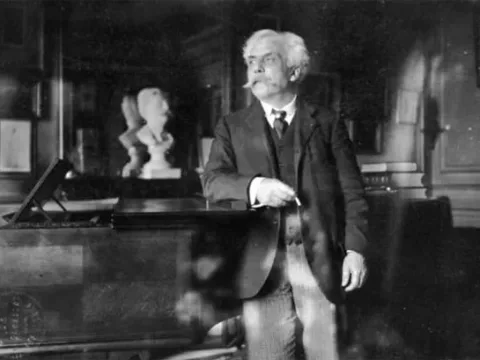
2 Comments »This week’s composer’s name is a joke. Apart from the soft-palate-rolled R endemic to my people (and some Italian people around Torino with a strong erre moscia), this should not be a problem for anybody in the US. Have you guessed it? Gabriel Fauré.

If you can pronounce 4-A, you can then pronounce the name of the composer of the famous Requiem, some beautiful piano quintets, and memorable melodies. So, just in case it still represents an issue for you, here’s the MP3:
Audio clip: Adobe Flash Player (version 9 or above) is required to play this audio clip. Download the latest version here. You also need to have JavaScript enabled in your browser.
Link to MP3: ICIYL – Gabriel Fauré
Gabriel Faure’s
“Agnus Dei” from
Requiem in D Minor Op.48
Written between 1887 and 1890
I have to admit that I’m quite fond of his music, even though I still don’t understand, to this day, his comment on Ravel’s string quartet (that Ravel respectfully dedicated to his “cher maître”, dear master): “stunted, badly balanced, in fact a failure.”
Well, I’d love to write this kind of failures every day Gaby. Word.
Was this helpful? Is there any other name (composer, piece, instrument, etc.) that you would like to see on these pages? Just post a comment or find me on Twitter: @tonalfreak.