Archives for September, 2011

28
Sep

So Percussion plays Steven Mackey’s It Is Time at AIR: From time to space… and back

Yesterday night, So Percussion was having a release party for Steven Mackey’s It Is Time (Cantaloupe).

Hosted by AIR (Art International Radio) in lower Manhattan’s historic Clocktower Gallery (how à propos), the show was actually taking place right beneath the clock, in an intimate space featuring a curvy steel and Plexiglas structure. The room was quite packed when the clock stroke 7 and the concert began.

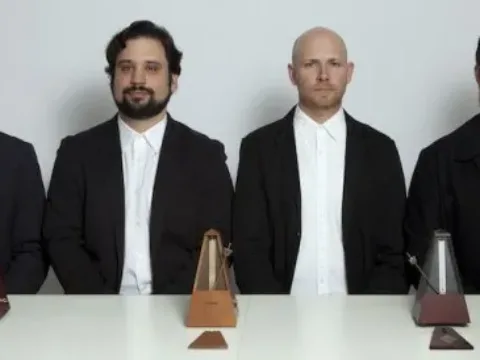
So Percussion

It Is Time is a quadruple percussion concerto written by Steven Mackey, one of the most badass living composers out there. The concerto is divided in 5 movements: Metronome, Steel Drums, Marimba, Drums, and Epilogue, for a total duration of about 40 minutes.

The first movement started with an analog metronome ticking, soon echoed by imitative syncopated rhythms on temple blocks. The high pitched wooden ticks filled the space with a rare sense of urgency as a micro gamelan of small bells entered. The syncopation got wilder and wilder, slowly blurring the pull of the metronome that ended up disappearing. The rigid textural space created in the first movement was followed by a more resonant and metallic one, centered on the steel drums.

So Percussion - Josh Quillen on steel drums

Josh Quillen on steel drums

The subjective perception of time really got altered by these lush, free passages on the steel drum and—as if the contrast was not strong enough—the introduction of a microtonal steel drum finished to liquefy the notion of time (the projected video by Mark DeChiazza was then showing drops of white liquid slowly dripping in a white tank). The metronomic pulse reappeared as a Newton’s cradle, but this time it was more perceived as an echo, a consequence, than really a guiding force.

The marimba (played by Adam Sliwinski) entered, for the third movement, and shaped some beautiful echoing waves. The echo was not due to the space itself but written in the score, and one might think that the composer wanted to focus more on the audience’s awareness of the auditory space. From time to space. Seamlessly, the drums emerged and Jason Treuting delivered an incredible fourth movement that was free, controlled, and sometimes outlining a melody on the crotales in the middle of a break. I personally felt that the movement culminated in a sick drums/cowbell duet that would’ve taken Bruce Dickinson’s fever away. From space to time?

Steven Mackey, Jason Treuting and Josh Quillen chilling after the concert

Overall, the piece offers some quiet, introspective, very suggestive moments and infectious grooves flirting with jazz, rock or, as Mackey’s bio states:

vernacular music from a culture that doesn’t actually exist.

The CD comes with a full DVD by Mark DeChiazza which goes beyond a simple video recording of the performance, and adds a layer of interpretation to this already rich piece. Here’s a trailer:

So Percussion: Steve Mackey's IT IS TIME

Do you have a favorite Mackey piece? Or a So Percussion album? Please, feel free to post a comment or find us on Twitter: @icareifulisten

26
Sep

French Composers’ Names — Georges Delerue

This week’s composer might be more famous among movie buffs than concert goers. Indeed, in 1981, French magazine Le Figaro dubbed him “Mozart of Cinema” (Georges Delerue le Mozart des salles obscures)…

Born in 1925 in Roubaix (Northern France), Delerue studied with Darius Milhaud and Jean Rivier at the Conservatoire de Paris and started, soon after, what looked like a very promising career in concert music (I would love to hear his opera Le Chevalier de neige (The Snow Knight) based on Boris Vian’s play Les Chevaliers de la Table ronde.) Milhaud advised him to start writing for the theater, and later for movies. This led him to collaborate with a plethora of directors (French or not—he wrote the OST for Oliver Stone’s Platoon in 1986) from Nouvelle Vague auteurs (Truffaut, Godard) to more popular figures (Philippe de Broca, Gerard Oury, etc.) Delerue died in 1992 in Los Angeles.

Georges Delerue

Georges Delerue (1925-1992)

The French u is basically the only issue here, and should not sound like a oo. The two unaccented e in his last name sound like uh for English speakers. The final s in his first name and the final e in his last name are not pronounced.

Audio clip: Adobe Flash Player (version 9 or above) is required to play this audio clip. Download the latest version here. You also need to have JavaScript enabled in your browser.

Link to MP3 – ICIYL – Georges Delerue

I discovered Delerue’s music when I was living in Italy, and was really moved by the track below, part of the soundtrack of La Meglio Gioventù by M.Tullio Giordana (2003). I realized later on that it was originally Catherine et Jim‘s theme in Truffaut’s Jules et Jim (1962).

Georges Delerue – Catherine et Jim

A great recording of his music for Truffaut’s movies is available on Amazon (CD or MP3 download):

Did you know Delerue’s music? Would you like to see another composer featured in this series? Please, leave a comment below or find me on Twitter @icareifulisten

22
Sep

5 questions to Cory Bracken (Percussionist, Executive Director of Stellar Frequencies)

The third installment of Stellar Frequencies this weekend in Fort Greene Park was the ideal opportunity to talk to Cory Bracken and let him share some ideas about accessibility, repertoire, and where culture really happens today.

What is the idea behind the Stellar Frequencies concert series and its title?

A simple assessment: I am interested in transcending scenes for the deeper consideration of community.  Spend enough time in a cultural environment like New York, and suddenly these terms are illuminated.  It seems as though music exists in a thousand unique orbits in this city, determined by the gravity of a particular “scene”.  It’s weird to me.

A loftier assessment: Stellar Frequencies is interested in reconsidering the cultural context of innovative music in American society.

Further: Stellar Frequencies is interested in challenging what I call the “esoteric assumptions”; the notion that a more “general” public is incapable of “understanding” an artistic work of an avant-garde or experimental nature, and therefore is equally incapable of properly “appreciating” it.  I don’t think this is the case at all.  It is necessary to identify distinctions regarding this “understanding” of a musical experience.  Should a listener be capable of readily identifying the particulars of advanced harmonic, rhythmic, and timbral activity in a composition, utilizing the language of the western music tradition?  Surely, if this is the criterion for a deeper, truer appreciation, than the music of the western avant-garde is, in fact, esoteric.  Quite honestly, that sounds silly to me.  In terms of the Stellar Frequencies musical experience, structural implications are of lesser value against the experience of the architectural whole.  I have discovered that the results of a highly advanced musical language can be absolutely penetrating, mesmerizing, spiritual, and in this respect, everlasting; and, perhaps it could be so for anyone who listens.  But, that is a matter of opportunity.

Musicians speak very often of “professionalism”.  I believe a professional can be defined as a person with a specific set of skills who goes where they are needed and provides a worthy service to their community.  As a performer and general practitioner of the avant-garde tradition, I have arrived to an important realization: any institution that propagates these “esoteric assumptions” will succeed in further dividing the community, and therefore is the very last place we should go, for that is where we are not needed.

What triggered the creation of Stellar Frequencies?

Opportunity.

Stellar Frequencies is entirely informed by the idea of accessibility.  It is important to identify this term in two separate contexts: aesthetic, and literal.  We have experienced plenty of the former… a kind of approach to musical composition that is interested in utilizing certain “experimental” concepts, but still preserves aesthetic aspects that are readily identifiable and agreeable to an extensive cross-section of ears — the use of diatonic harmony (or modifications of it), repeating and perceptible rhythmic activity, traditional casts of general musical forms, and so on.

I must be clear at this point that I am not identifying these aspects of composition because of an opposition to this approach: quite the contrary, as I often enjoy this music.  Rather, this is to clarify a larger idea in this critical word accessibility — Stellar Frequencies is not concerned with solely promoting an accessible aesthetic, as it is wholly occupied with the literal context.

So what does that mean?  A thought: I do not believe that Lincoln Center is a truly public venue for music and the arts, in the same way I do not believe that a concert at Miller Theater is truly public, or any recital hall in most any institution, Conservatory or otherwise.

The idea here is simple.  Any reader of this article does not require notification from me or anyone else that cultural institutions like Lincoln Center or Miller Theatre are not on the radar of the public, of the true public, because it is not an aspect of their cultural routine.  The vast majority of citizens would never consider attending an event there because they don’t even know that it exists, or the cultural implications are too vast, too intimidating to deal with.  The concert etiquette of “sit down and be quiet”, coupled with the confounding language that fuels the “educated opinion” of the audience, is off-putting to say the least.  Add to this an aesthetic of music that is completely alien (because it was not exposed to them at any point in their lives), and you unfortunately arrive at the idea of what “classical” and “avant-garde” means to the broader public.

So… what if you were to remove the music from this rather sterile environment that is so culturally threatening?  Say, a place that is familiar, welcoming, an aspect of your cultural routine… a bar, sidewalk, train station, or in the case of Stellar Frequencies #3 in September of 2011, a public park.

This would be a good time to identify the incredible efforts of (certain) individuals and arts organizations in New York City to provide a wealth of music that is free and public in a variety of artistic aesthetics.  This is, of course, commendable, and most artistic denizens of New York would agree.

With that said, lets stir the pot with a brash statement, because honestly, I’m sick of the lack of controversial declarations in modern music discourse:

The Euro-centric institutional mechanisms have claimed a certain ownership of avant-garde western musical thought, and frankly, I think that’s bullshit.  With this statement, I am aware of three truths: I am not the first, I am not alone, and I will not be the last.  Their old-world money and powdered-wig tendencies have clearly defined a cultural (and economic) elite that seems fairly lacking in concern for a broader public.  Stellar Frequencies has no interest in stroking the colossal ego of the bourgeois classical or avant-garde art community, and never will.  Instead, it will always strive to obliterate the tendencies of institutional thought that haughtily prescribe esoteric assumptions about the musical experience for anyone outside of its hermetic, cloistered environment.  Clearing this obstruction is at the heart of this “reconsideration of cultural context in American society”.

Likewise, Stellar Frequencies has no interest in pandering to the tastes of exclusive “scenes” in all kinds of music and art beyond the institutional influence.  I have noticed a disconcerting tendency for an absolute aesthetic homogeneity in certain musical spheres, and I intend to promote a kind of integration in this respect.

Perhaps you don’t agree.  In fact, I hope you don’t agree, and I hope you broadcast it on this blog.  Then maybe we’d have an edgy discussion for once in this sea of mediocrity that is so mistakenly identified as “new-music”.

[Read more →]

20
Sep

Introducing your Students to Modern Music

One of my biggest concerns in classical music today lies in the area of education. While most kids have at least some familiarity with the masters of the Baroque, Classical and Romantic eras, there is little exposure to early 20thcentury composers (usually limited to Prokofiev and Britten), and no exposure to living composers. For some time this has baffled me, as while the general populace has the opinion that modern classical music is dissonant, unorganized nigh-noise, someone who has been through formal training should be aware that there are more similarities than differences between the modern master and the classical master. As such, I offer three pieces by living composers that can be paired with works by the classical masters for an effective lesson.

When choosing these pieces I kept three basic rules in mind:

John Adams – Short Ride in a Fast Machine

Short Ride in a Fast Machine by John Adams

This short energetic piece is built entirely off small rhythmic motives, from the pulse of the woodblock to the syncopated rhythms in the brass, and can serve as an excellent introduction for minimalism. The motives are clear and transformations are relatively easy for the ear to follow. I would recommend pairing this with the first movement of Beethoven’s 5th Symphony, and discuss with the class the similarities and differences in each composer’s approach.

Jennifer Higdon – Piano Trio: I. Pale Yellow

J. Higdon – Piano Trio – Pale Yellow

Lush, rich melodies dominate this work, as the ensemble shifts almost seamlessly between playing in a melody, harmony, accompaniment scheme into a contrapuntal setting. Each player is in the spotlight at times, as the melodic line drifts from one part to the next. In a lesson, this piece could be paired with another chamber work, such as Brahms’s Piano Trio No. 2 in C Major, Op. 87 to serve as an introduction to chamber music, or with a classical symphony such as Mozart’s 40th Symphony in G Minor to discuss the difference between chamber and symphonic works, especially in regard to the use of instruments.

Nico Muhly – I Drink The Air Before Me: First Storm and Storm Centre

Unfortunately, there aren’t any videos of this on Youtube, but I did find the pieces on Spotify (as well as the others) and will share the link at the bottom of this post. This work is excellent for discussing program music. Nervous, energetic bursts from the instruments, convey all of the excitement and energy of a violent thunderstorm. Pair this with the Presto movement from Vivaldi’s ‘Summer’ and discuss the similarities and differences of each composer’s representation.

This is of course only an introduction into thinking of contemporary music in a different light. Start branching out and seek pieces that can be used in your lessons, and to introduce your students to living composers. Can you think of any other pieces to use like this? How will you use modern music in your classroom?

Spotify playlist: Three Great Pieces to Introduce Kids to Modern Music


Tai Livingston is a composer and an educator. You can follow him on twitter @texancomposer.

16
Sep

French Composers Names’ — Hugues Dufourt

This week’s composer is Hugues Dufourt, another clever chap. Born in 1943 in Lyons, Dufourt trained both in Philosophy and Music at the highest levels. He was one of the directors of Ensemble L’Itinéraire in 1975 and founded the Collectif de recherche instrumentale et de synthèse sonore (CRISS) with Alain Bancquart and Tristan Murail.

Hugues Dufourt

Hugues Dufourt © Astrid Karger, www.astrid-karger.de

His last name features a pure ü and a pure oo sound next to each other. The French u sound, that I often write ü for people who might be familiar with German, is pronounced by saying ee while one’s mouth is in an o shape. Try it, it’s fun. The final consonant (t here), as often in French, is not pronounced. It’s just to score higher at Scrabble.

Here is the MP3:

Audio clip: Adobe Flash Player (version 9 or above) is required to play this audio clip. Download the latest version here. You also need to have JavaScript enabled in your browser.

Link to MP3 — ICIYL – Hugues Dufour

Here’s a video of the Amstel Quartet playing Dufourt’s Saxophone Quartet (1993)… I just love saxophone quartets, don’t you?

Amstel Quartet plays Hugues Dufourt

Was it useful? Any other composer’s/piece’s name you’d like to see featured? Post a comment or find me on twitter: @tonalfreak.

12
Sep

A few pictures from Music After

Initiated by composers Daniel Felsenfeld and Eleonor Sandresky, Music After was a day-long concert featuring music by composers who were living in downtown Manhattan on 9/11: Annie Gosfield, Carter Burwell, Charles Waters, Dafna Naphtali, Daniel Felsenfeld, David Bowie, David Byrne, David Del Tredici, David First, David Lang, David Linton, David Soldier, Don Byron, Eleonor Sandresky, Elliot Sharp, Elliott Carter, Eve Beglarian, Hans Tammen, Harold Meltzer, Joan La Barbara, Joanne Brackeen, John King, Jon Gibson, Jonathan Hart Makwaia, Judd Greenstein, Judy Nylon, Julia Heyward, Julia Wolfe, etc. (full list here). It was also conceived as an alternative to the list of names, the speeches, the politics… that were taking place elsewhere and just created a space where composers could come and share something closely related or not with their experience of 9/11 and their life after.

The event took place in the beautiful annex of the Joyce Theatre in Soho, a three-story former firehouse located at 155 Mercer. The concert symbolically started at 8:46 and went on until midnight. I could only attend a very small portion of it but the line up was impressive: Laurie Anderson, Joan LaBarbara, Daniel Felsenfeld and Rick Moody, Michael Friedman accompanying Robbie Sublett, Charles Walters (Sparkle Trio), …

Sparkle Trio

Charles Waters and Sparkle Trio

I really enjoyed the intimacy of the space and the freedom that was given to the performers. Over the span of a couple of hours, the music seamlessly went from the vocal soundscaping of Joan LaBarbara (Gate Keeper) to the beautiful A Hudson Cycle by Nico Muhly (more about this piece + excerpt) performed by Eleonor Sandresky, and to Rick Moody and Daniel Felsenfeld covering Lou Reed’s Perfect Day.

Rick Moody and Daniel Felsenfeld cover Lou Reed

Rick Moody and Daniel Felsenfeld cover Lou Reed

I sometimes almost had the impression to be part of a good friend’s remembrance as all the performers seemed approachable and fragile. Felsenfeld gently led the event, introducing the acts in a low, friendly voice.

Michael Friedman and Robbie Sublett

Michael Friedman and Robbie Sublett

The variety of genres and affects created an emotional mosaic that might have reflected the unique feelings of the audience: even though I clearly remember this day, 10 years ago, I was not present in downtown Manhattan, not even in NY or this country. Still I was profoundly moved by all the acts and their individual stories told in music (or prose for Laurie Anderson).

Taylor Levine performing Laurie Spiegel's "New York November 2001"

Taylor Levine performing Laurie Spiegel's "New York November 2001"


Next Page »