Posted by David Pearson »
Add Comment »
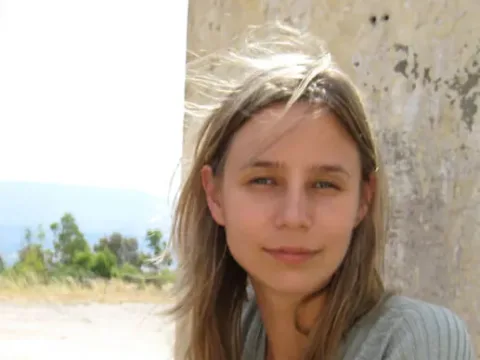
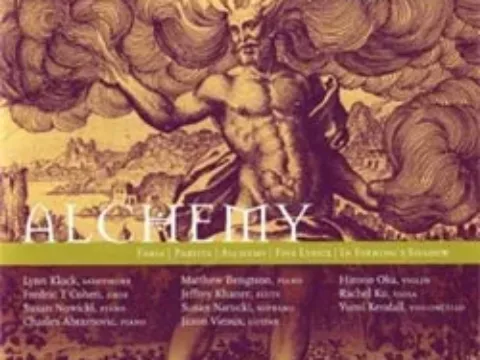
Albany’s release of recent works by Jan Krzywicki captures the unique and coherent voice of this Philadelphia composer at his best. The CD, titled Alchemy, highlights Krzywicki’s expressive and intuitive writing for woodwinds, the wall of sounds he pulls out of the piano, and an impressive blend of soprano voice, string trio, and guitar. Krzywicki’s highly individual style and musical language craft beautiful musical narratives out of mostly dissonant material that have a strong impact on the surface and leave you contemplating their implications.
I first became attracted to Krzywicki’s music through learning and performing his piece Fable for baritone saxophone and piano. I was particularly taken with the narrative structure of Fable: the way the music drew itself out of a simple beginning and built through numerous twists in the story, finally reaching a conclusion that was both dramatic and takes time to mentally digest. As a performer, I was impressed and challenged with Krzywicki’s meticulous attention to expressive detail, especially articulations, including ones that really gave the music an aggressive punch. The range of sounds demanded of the baritone saxophone, starting from nothing and going to the brink, made it one of those pieces I really had to put everything into emotionally and technically.

Jan Krzywicki
[Read more →]
Posted by Thomas Deneuville »
3 Comments »
Last week, Make Music New York introduced a new annual event: Make Music Winter. For its first installment, twelve musical parades were scheduled, proceeding through neighborhoods in Manhattan, Brooklyn, and Queens. Participating artists and organizations included the Metropolitan Museum of Art, Cathedral of St John the Divine, Friends of the High Line, Parsons The New School for Design, composer Phil Kline, MATA, The Knights, conductor Harold Rosenbaum, Puerto Rican folk group Los Pleneros de la 21, Arabic music ensemble Zikrayat, and many more…
I decided to cover The Gaits and headed to the High Line to participate in a unique soundwalk created by Lainie Fefferman, Jascha Narveson, Cameron Britt, and Daniel Iglesia. A free iPhone app was required to fully enjoy the experience: the application used the accelerometer, as well as the GPS location to trigger twinkling metallic and liquid sounds, electric guitar chords, organ drones, applause, etc. The portable speakers were kindly loaned by the High Line…

[Read more →]
Posted by George Heathco »
Add Comment »
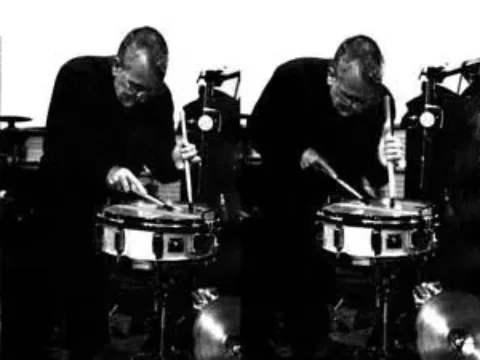
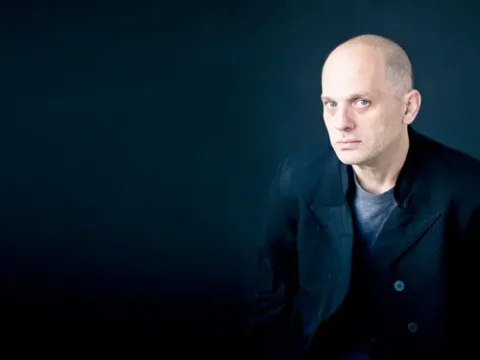
Hippos Epos is the latest release by Italian percussionist Sebastiano de Gennaro, on Trovarobato’s Parade label. Of the six pieces contained on the disc, three are original compositions for percussion and electronics (Donald Fauntleroy Duck, Electric Poneis, Musica per Aristofane), two are highly imaginative reinterpretations of major works from the cannon (Kindersinfonie, and Bach’s Brandenburg Concerto no. 2), and one is a faithful interpretation of a minimalist landmark (Steve Reich’s Music for Pieces of Wood). It seems highly appropriate at this point to issue a bit of a spoiler alert for any interested reader, as the six titles represented on Hippos Epos are heavily steeped in irony, sarcasm, and humor.

Sebastiano de Gennaro
[Read more →]
Posted by Paul Kilbey »
Add Comment »
The free improvisation group AMM have, remarkably, been active since 1965, and founder-member Eddie Prévost has been a constant presence. Cornelius Cardew was a long-standing member, and occasional collaborators include Christian Wolff and Evan Parker. Ornette Coleman was apparently asked to leave.
The group may be exactly twice my age, but, as one would hope from free improvisers, they still perform with freshness and huge imagination. Their performance in the fashionable Café Oto in Dalston, London was a testament to the sustainability of improvisation as a musical way of life.

Eddie Prévost – Photo by Vanita & Joe Monk www.monastery.nl
[Read more →]
Posted by Rob Wendt »
Add Comment »
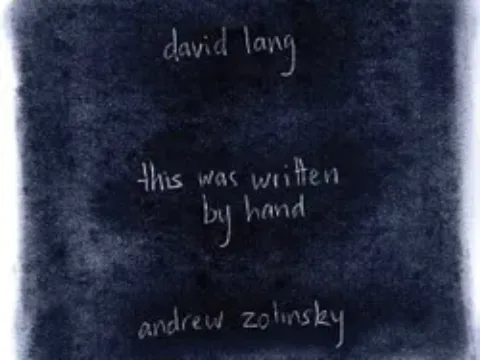
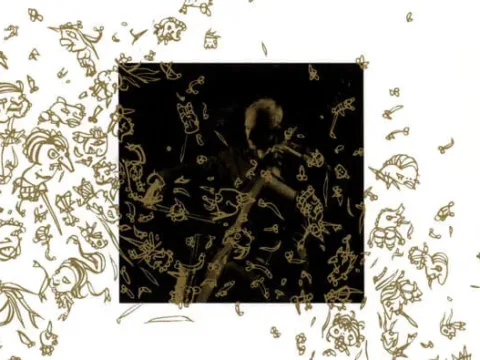
On his new album from Cantaloupe Music, this was written by hand, David Lang treats the piano alternately as a eulogizer and as a medium to commune with the departed. Pianist Andrew Zolinsky’s technique is well suited to tastefully render these finely wrought improvisatory pieces, to sound out the meditative character of Lang’s postminimalism. The range of piano articulation presented here stretches from use of the instrument as pitched percussion all the way to liquid, dulcet burbles. Piano music in the contemporary classical world often embraces jazz tropes, or world music idioms, or past stylistic genres. Lang’s piano voice sometimes recalls the phase music of Reich but is for the most part quite original in its complete metrical flexibility (or complete lack of meter in some cases, it seems), and in the way it exhaustively explores all the possibilities of a spare musical form. The tracks here are all character pieces in my opinion. There are no grand statements; on the contrary, the prevailing voice is one of personal introspection, without a hint of sentimentality.

David Lang
[Read more →]
Posted by Steven Berryman »
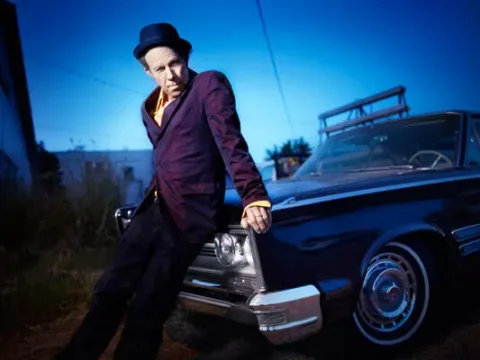
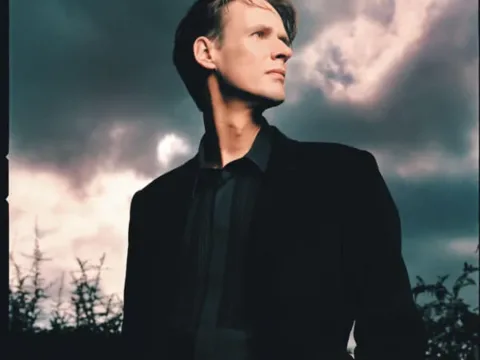
Add Comment »It made a welcome change to a conventional Christmas concert to go and hear in the North Sea Radio Orchestra, supported by Wilderthorn, last Friday. The venue—St Olave’s—is a beautiful church right in the heart of the City. All the prerequisites for a festive event were in place: Christmas trees up, mince pies, mulled wine and a raffle, and a full and supportive audience. Wilderthorn, who is the singer Jon Bilbrough, opened the evening with a set of his own songs that not only showed his strong vocal but his music is imbued with influences from his earliest musical experiences touring and performing in Sri-Lanka, Malaysia, Singapore and India. Jon was accompanied by the violinist James Underwood who added sensitive colouring to Jon’s guitar playing. The opening song was full of features that characterised much of his material; a soaring vocal line often coloured with ornamentation one might hear in Indian Classical singing, interesting harmonies, inventive guitar riffs and a keen ear for subtle timbres. “The Lion’s mane” made use of the loop pedal to sustain a pattern that was not unlike the tambura drone found yet again in Indian Classical music with James’ playing always blending beautifully with Jon’s. Wilderthorn’s work focuses on strong lyrics-lines like “swam all day to drown you out” in “The Spell” but all the songs presented were similar in character and mood tempo wise. Most impressive was his vocal ornamentation through all his set.

Wilderthorn
[Read more →]