Archives for January, 2012

31
Jan

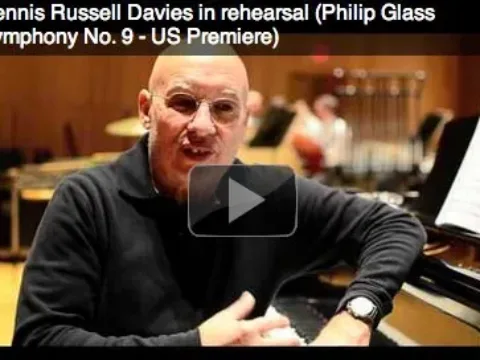
Dennis Russell Davies in rehearsal (Philip Glass, Symphony No. 9 – US Premiere)

Dennis Russell Davies in rehearsal (Philip Glass Symphony No. 9 – US Premiere)


Today, on his 75th birthday, the American Composer Orchestra (ACO) will be performing the US premiere of Philip Glass’s Symphony No. 9. We were at the rehearsal and talked briefly with Dennis Russell Davies. Happy birthday Philip Glass!

Thank you to the ACO for letting me shoot part of the rehearsal.

American Composers Orchestra - http://www.americancomposers.org

Video + Editing + French accent: Thomas Deneuville
Opening animation: Daniel Thompson at DTWebart (http://www.dtwebart.com)

© 2012 I Care if You Listen

30
Jan

Posing Questions: Wolfgang Rihm at 60

Southbank Centre2012 sees the 60th birthday of the prolific composer Wolfgang Rihm and the London Sinfonietta curated a concert that included three UK premieres of Rihm works in addition to two works by composers who at some point in their training were taught by Rihm: Rebecca Saunders and Jörg Widmann.

Wolfgang Rihm - Photograph by A.T Schaefer

[Read more →]

27
Jan

Focus on Schoenberg at the Austrian Cultural Forum

On January19th, the Austrian Cultural Forum presented the first concert in a new lieder series led by virtuoso pianist, Thomas Bagwell.  The focus of this series is–quite appropriately, given the venue–the founder of the Second Viennese School, Arnold Schoenberg and his composition teacher turned brother-in-law, Alexander Zemlinsky.  This first concert was dedicated to Schoenberg and Zemlinsky’s early songs only (all selections on the program were composed between 1889 and 1903).  The fact that Zemlinsky’s lieder were not published until 1995 and that they are so infrequently programmed makes their performance an event in itself.  Nevertheless, they were not the only novelty offered that evening.  In his introduction to the first set of Schoenberg songs, Bagwell dubbed these early works, “some of the best songs that Brahms never wrote.”  A joke perhaps, but few could argue with him.  Even Schoenberg’s better known opus 2 and opus 3 songs (performed during the second half of the program), were a startling reminder of Schoenberg’s less-than-revolutionary compositional beginnings.  It is difficult to imagine that these chromatic, (yet thoroughly tonal) gems of late 19th-Century song literature were penned by the same man famous for Ewartung, Moses und Aron, and Pierrot Lunaire among other atonal masterpieces.  Anyone expecting the music to “sound like Schoenberg” was in for quite a surprise.

Sharla Nafziger (soprano), and Michael Slattery (tenor)

[Read more →]

26
Jan

Beauty from Ugliness

Discussing aesthetic principles and ideals is always a subjective topic, with the totality of what is “beautiful” or “sublime” being unique to each individual. Where one may find the music of Webern beautiful and deep, it may have others fleeing for the exits. As such, any conversation on “what is beautiful” usually ends in disagreement on at least one or two points.  This post will not likely present any music that is new to regular readers and contributors. Rather, I’m asking you to listen to the selections with a different set of ears, and to try find the beauty in the ugliness.

I have a very unusual and quirky aesthetic. I revel in jarring dissonance and unusual rhythms. I enjoy unstable tonal schemes and uneven forms. I truly am blessed to be alive in the climate of eccentricitythat dominates the contemporary music scene today. However, this climate is so far removed from the music of Bach and Handel, one does question how we arrived at this place.

Art is, and always has been a direct reflection of the society that created it. The music of the Baroque was the result of shaking the chains of an oppressive European theocracy, the ending of superstitious mysticism, and the beginning of rationalism. The music of the Classical masters is, to my ear, an exact musical interpretation of Enlightenment Era philosophy. The music of the Romantics conjures up the same fantastic images as the writers of the same time period do in their books. So why did Debussy feel the need to begin using unresolved sonorities? Why did Stravinsky assault his listeners with jarring uneven rhythms? Why did Schoenberg feel the necessity to ‘emancipate the dissonance’?

[Read more →]

25
Jan

An earthly abode for ethereal sounds: Claire Chase’s “Terrestre” release party

On January 17th, Claire Chase celebrated the arrival of her new CD, Terrestre (earthly in French, Ed.)The setting was Le Poisson Rouge, and the ambience was set smoothly before a single note was played, as the room was lit primarily by swaths of cool blue lights and warm red ones, in a jagged pattern. The house was packed, and the crowd was eclectic, as twenty-somethings, hipsters, and the baby-boomers were all well represented.

Starting the evening off was Glacier, a minimalist piece written by Dai Fujikura for solo bass flute. The bass flute is not often seen or heard, and after seeing and hearing Chase play it, one wonders where this magnificent instrument has been hiding. The piece opened mysteriously on an open fifth, and proceeded like a soliloquy with great expressive range. While the timbre began gently, warm, and with an airy vocal quality, even approaching a plainchant, there was soon much more vigor, with multiphonics, trills, warbling sounds, even honking and blasting at times. The music was divided nicely by carefully measured periods of silence. It ended on a repeating descending tritone, fading away.

Claire Chase - Photograph by Stephanie Berger

[Read more →]

24
Jan

Asphalt Orchestra at the Met Museum

Asphalt Orchestra at the Met Museum

To celebrate the renovation of the Metropolitan Museum’s New American Wing Galleries for Paintings, Sculpture, and Decorative Arts, Asphalt Orchestra—”Not your mother’s marching band” (The Philadelphia Inquirer)—performed in the American Wing’s Charles Engelhard Court.

The performance featured a world premiere arrangement by Ben Holmes of the Hymns Cavalry by Daniel Read and Sons of Sorrow by William Hauser from the distinctly American shape note singing tradition, inspired by field recordings from the 1940s-1960s; Carlton by Stew and Heidi Rodewald, a work commissioned by Bang on a Can for the Asphalt Orchestra; an arrangement by Stephanie Richards of the Laneville-Johnson Union Brass Band’s Wild About My Daddy; and an arrangement by Peter Hess of Frank Zappa’s Zomby Woof.

The program was choreographed specifically for the Engelhard Court by Mark DeChiazza and Susan Marshall (note that this edited video does not fully reflect the choreography).

■ Asphalt Orchestra http://www.asphaltorchestra.com

■ Bang on a Can http://www.bangonacan.org

■ Metropolitan Museum http://www.metmuseum.org


Next Page »