Posted by Thomas Deneuville »
5 Comments »
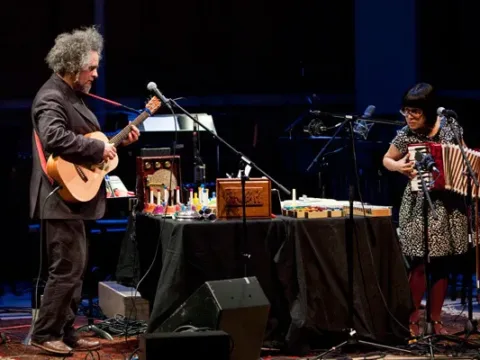
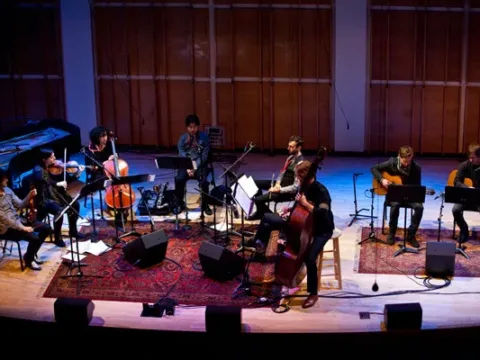
For a vegetarian, going to a vegetarian restaurant (or an allergen free restaurant for someone suffering from food allergies, etc.) brings a relief that is rarely experienced by omnivores: it feels safe. Everything on the menu is OK, whatever the name of the entree is, how obscure the list of ingredients looks, or exotic the dressings sounds. On February 8th, I was surprised to experience the same relief sitting in Merkin Hall, waiting for the concert to start. I knew who I was coming to hear, but I had voluntarily limited my research to enjoy the fuzzy knowledge of what was going to happen. Why? Because it felt safe. The chances of coming across a pretentious, untalented act were close to zero. The night would be full of collaborations, and unique.

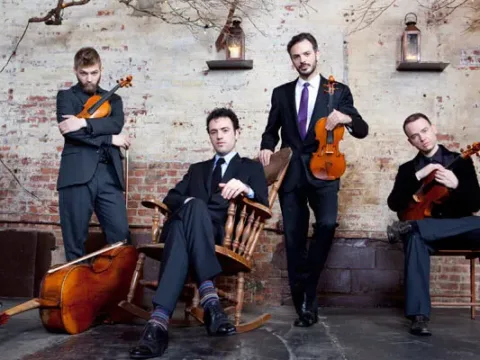
yMusic, Richard Reed Parry, and the Dessner twins - Photograph by David Andrako
[Read more →]
Posted by David Pearson »
1 Comment »
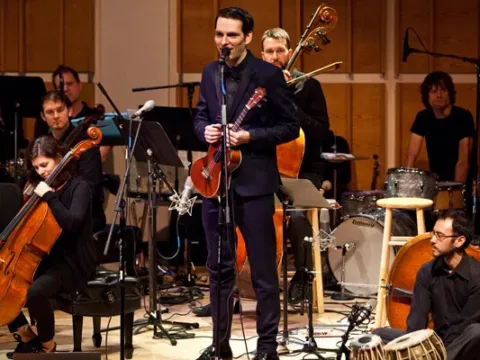
The Fast Forward Austin new music festival brought the noise to NYC with a concert February 23rd at the Contagious Sounds Series. The Bel Cuore Saxophone Quartet proved itself as an ensemble with a broad sound palette, a down to earth stage presence, and tremendous communication and spontaneity. Their selections highlighted the numerous qualities of the saxophone, from ethereal blends, lyrical wanderings, punched accents, catchy grooves, to quick dynamic contrasts, all in a way that was quite listener-friendly. With the exception of a brand new piece, they performed without music, making the spontaneity and group dynamic far more organic.

Bel Cuore Quartet - Photograph by Nathan Russell
[Read more →]
Posted by Thomas Deneuville »
1 Comment »This weekend’s Ne(xt)works’ Music Without Dance—a multi-event festival focusing on recent and historical musical works originally created to be heard with choreographed movement—was the perfect excuse to interview Joan La Barbara and talk about dance, as well as Phase Two of Storefront Diva…
Your name is usually associated with a life-long relationship with voice but you have also written extensively for dance. What led you to do so?
I love dance. In fact, as a child I wanted to be a dancer but my mother read an article about ballerina’s bloody toes and decided not to let me study dance. She gave me piano and art lessons instead.
Anyway, I have watched a great deal of dance over the years and have been particularly influenced by Merce Cunningham’s independent moving of dancers in space (which I reflected in my work “Autumn Signal” as I moved the sounds around in space), and also his attitude that whichever way the dancers were facing was front (again, reflected in some of my sound sculpture works). I was very, very fortunate in 1976 to be invited to play my music with Merce in an Events evening. Ned Rothernberg and Peter Zummo were working with me at the time and we did several of my ensemble works as well as some of the solo material. The way the “Events” worked was that Merce told the composer how much time to provide music for, and he allocated sections of his dances to fit that time. I remember that just as I began to sing “Circular Song”, Merce began a solo, edging forward carefully one foot at a time, then pulling it back and making sudden gesture flurries with his hands. It was thrilling.

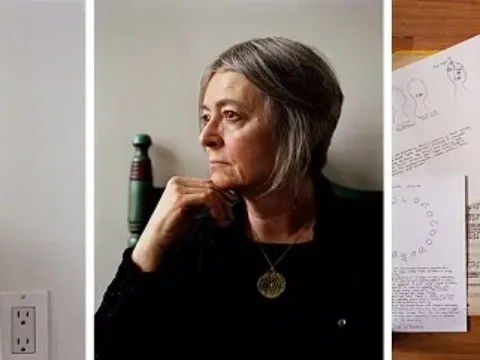
Joan La Barbara - Photograph by Mark Mahaney
[Read more →]
Posted by Rob Wendt »
2 Comments »
Pärt Piano Music by Naxos features pianist Ralph van Raat interpreting the Estonian composer’s music spanning over four decades. This retrospective takes us on a stylistic journey that is truly millennial in scope, while remaining reverent in spirit.
The first of the Zwei Sonatinen, Op. 1 (1958), shares much of the language of Pärt’s elder contemporary, Shostakovich, with acrobatic melodies supported by harmonies that become only occasionally dissonant, and then only through linear voice-leading. Ralph van Raat plays the allegro passages with a digital precision characteristic of post-war piano music. He imbues the largo passages, though, with a touching impressionistic quality. The second sonatina (1959) is quite another animal, with a jazzy improvisatory feel, recalling the dizzying flights of Oscar Peterson.

Arvo Pärt - Photograph by K. Kikkas
[Read more →]
Posted by Thomas Deneuville »
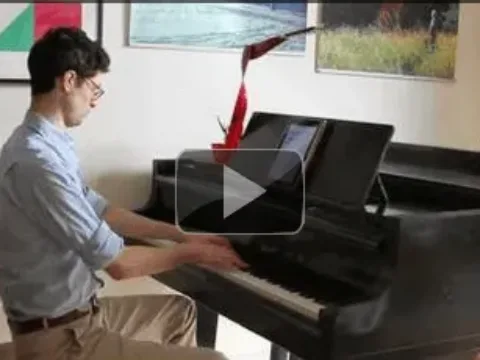
2 Comments »For this Hang #3, Timothy Andres welcomed us in his Brooklyn apartment. We talked about his Nonesuch album (Shy and Mighty), about popular music, typefaces and fresh mozzarella.
Here is the interview:
And here is a beautiful recording of Timothy playing At the River (2011) dedicated to Ingram Marshall, “whose work merges sacred and secular in mysterious and beautiful ways.”
Timothy Andres (b. 1985, Palo Alto, CA) is a composer and pianist. He grew up in rural Connecticut and lives in Brooklyn, NY. His compositions meld a classical-music upbringing with diverse interests in the natural world, graphic arts, technology, cooking, and photography. He has been praised for his “acute ear” by the New York Times’s Anthony Tommasini and “stubborn nose” by the New Yorker’s Alex Ross.
http://www.andres.com
Video + Editing + French accent: Thomas Deneuville
Opening animation: Daniel Thompson at DTWebart (http://www.dtwebart.com)
© 2012 I Care if You Listen
Posted by Paul Kilbey »
3 Comments »In Death to Kosmische you have the string quartet use a stylophone and an omnichord. In the past you’ve used an Atari 2600 games console. Is your fascination with the sound of these old electronic instruments, or with the technology, or both?
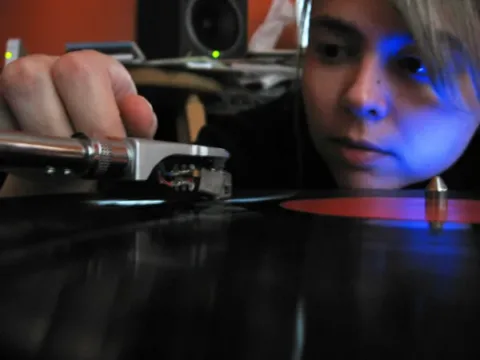
Both. My fascination with old electronics stems from my childhood. My father is an electronics collector/retailer/repairman and our house was always filled with various incarnations of electronic devices, many of them not working properly. By the time I came around the house was already full of vintage machines and this collection continued to grow throughout the 70s and 80s as we’d receive the latest device to test drive (Betamax machines, video disc players, video game consoles, etc.). I was always surrounded by these sounds so they became part of my subconscious. For me the sonorities generated by these machines feel very natural placed within an otherwise ‘traditional’ acoustic ensemble. Certain sounds have become iconic to me and I want to capture and manipulate these “icons” within a new environment. For example, the sounds from the first video games from the late 70s/early 80s: 8-bit, unrefined, gritty. When these are fused with orchestra they take on a new dimension. Or the voice: Slim Whitman sounds like Slim Whitman, Rob Halford’s falsetto scream is one of a kind – he’s done this for a long time and it’s been in my brain for 25 years. The only way to capture this very particular sound is to go straight to the source: on vinyl. I want to use these colours.

Nicole Lizée
[Read more →]