Posted by Matt Weber »
Add Comment »
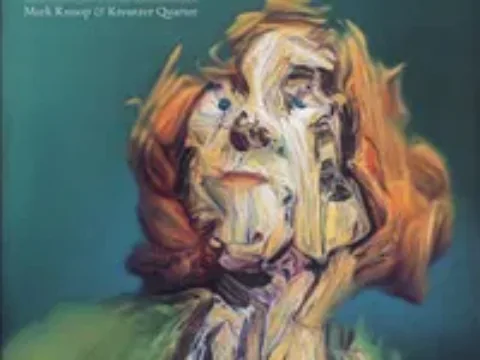
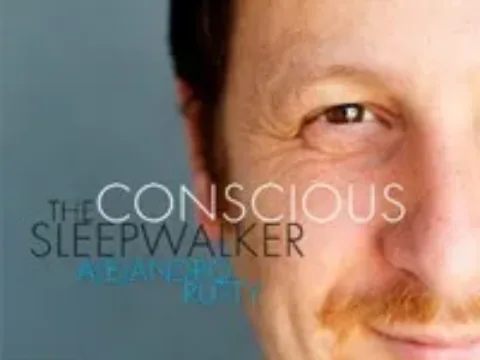
Alejandro Rutty’s new album The Conscious Sleepwalker is both a tour de force of the tango form, a deconstruction and re-imagining of that musical tradition. The grand, genre-spanning and genre-breaking ambitions of Rutty’s music are fully realized thanks to the precise and passionate execution of the performers. The album features two saxophone quartets, Cuarteto de Saxofones 4mil and Red Clay Saxophone Quartet, as well as 3 orchestral ensembles, the Mayan City Sinfonietta, the Moravian Philharmonic Orchestra, and the Kiev Philharmonic.
Since its first recognition as a distinct form in the 19th century, tango (both the dance and the music) has spread around the world and continued to develop and evolve. The tango composer most well-known to many listeners today, Astor Piazzolla, brought elements of jazz and even classical music into what had been a folk form. Rutty, building on the work of other tango experimentalists, goes even further, not only conceptually, but temporally and instrumentally as well. The “temporal” part comes from the beginning of the album, A Future of Tango, which is a three movement concerto for saxophone quartet (with orchestral backing) in which each movement represents what tango may sound like in a different, future year.

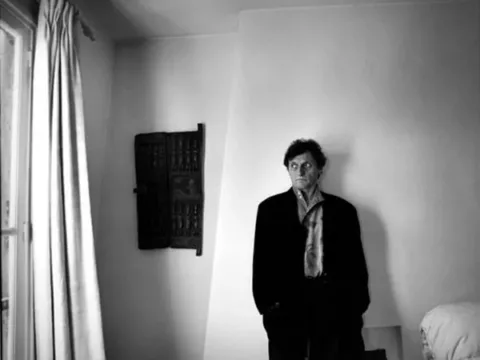
Alejandro Rutty
[Read more →]
Posted by Andrew Lee »
2 Comments »Since joining the I Care if You Listen team, I have been privileged to have the opportunity to review some great CDs. Often times these are CDs that I wouldn’t have otherwise encountered, and I’m grateful for the opportunity to be exposed to a variety of music. Of course, and I do hope that this comes as no surprise, the other great advantage is that I receive these CDs for free.
Let me say that I do take this responsibility quite seriously, and I’m lucky that our editor, Thomas Deneuville, allows us ample time to get reviews written. Rather than working on tight deadlines, I’ve had the opportunity to listen to each CD I’ve reviewed several times, and I hope that this experience of living with the CD has improved my output. Moreover, having had three of my own recordings released to date, I know very well the effort it takes for these discs to reach my mailbox.

Photo (some rights reserved) by chriszak - Flickr
There is, however, a downside, in that most of the music that has been recently added to my library has come from these CDs. It would be very easy for me to sort of kick back and see what is available for review (there is plenty, even for our relatively small number of writers), but then my collection would be self-selected. As we are all aware, there is an incredible amount of fantastic music being produced, and I for one am anxious to continue the hunt for gems. Moreover, and this is what has really bothered me, I am quite hesitant to simply stop supporting artists because their producers are sending me their material for free.
I’ve had an idea for a while, then, of reviewing on a monthly basis music that I’ve purchased. What the idea needed in order to come to life, though, was all the great discussion there has been about purchasing music and supporting artists. With so many people talking about an issue that is important to me, I had lost any excuses for not moving forward with this idea.
So I’m putting my money where my mouth is, and I promise to do my best to make these “Music I’m Buying” reviews a monthly occurrence. Hopefully, this will help me accomplish two things. First, and most obviously, I hope to bring to attention some great artists that deserve greater recognition. Second, and perhaps more importantly, I hope that I can, in my own small way, encourage people to buy more music.
Let me leave you with this quote from David D. McIntire, who, you should know, produces my own CDs. I hesitate to quote him as it may seem a bit self-serving, but I truly couldn’t have said it better myself.
So here is one more heart-felt plea from some artists who do not care to get rich, do not want anything more than to be able to continue: If you hear a stunning original recording, a performer that intrigues you, that moves you, perhaps even irritates you; take note. If you truly respect their work, the highest compliment that you can pay them is to spend your own money on their efforts. Go hear them perform, buy their stuff. Give it to others for birthday and Christmas gifts (the only kind of “sharing” that really counts). It will do more than help keep those artists going. You may find that their work will keep you going, too.
(From Words About Music: In Which I Chime in on a Matter Under Discussion.)
Posted by Elias Blumm »
Add Comment »“They will not let me off till I go with them, respond to them…”
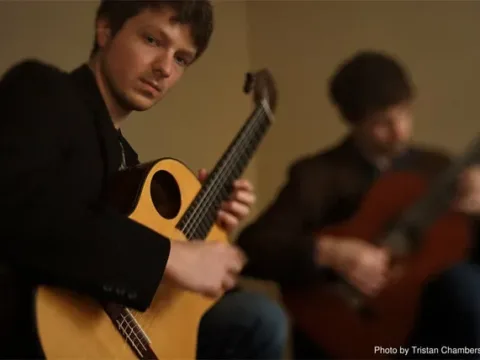
In the poem “I Sing the Body Electric” from his masterpiece Leaves of Grass, Walt Whitman ruminates on humanity, the love he consents to accept, and the love he is willing to give. In the context of Duo Orfeo’s newest record, I sing the body electric, the meaning of those words broadens to include an artistic longing, one that drove two musicians to apply an inspired spark of originality to “go with” and “respond to” music that called to them but had hitherto been evasive and inadequate on their chosen instruments. For Joe Ricker and Jamie Balmer, two of a crop of young, classically trained guitarists who are finding new means of expression through finely honed technique, I sing the body electric is a milestone record that encompasses their pedigree and their passion in a completely original and captivating way.

Duo Orfeo (Joseph Ricker and Jamie Balmer) - Photo by Tristan Chambers
[Read more →]
Posted by David Pearson »
2 Comments »
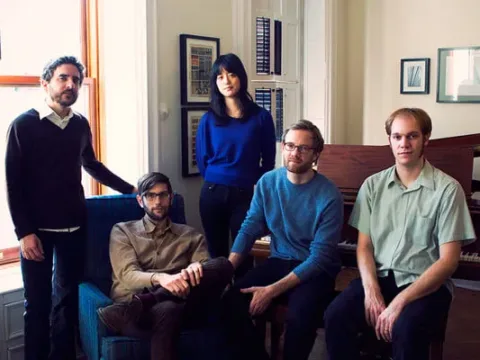
June 12th at Drom in NYC was a meeting of contemporary art music sensibilities with a rock/pop format. The result was something that was inviting, catchy, and groove-oriented but at the same time cerebrally satisfying. Build is a self-described indie-classical band whose compositions draw out the strength of each of its individual members and put infectious string melodies front and center. Empyrean Atlas’s music is driven by interlocking loops or guitars and saxophone with drums and building dynamics defining larger structures. Both groups gave enticing performances that were a solid departure from much of the drivel that abounds in the “art-rock” scene of New York.

Build - Photo by Jen McManus
[Read more →]
Posted by Thomas Deneuville »
Add Comment »I am very pleased to announce that the Summer 2012 Mixtape is out! It is completely free and just a click away (alright… two clicks away). It features Duo Orfeo performing Arvo Pärt‘s Spiegel im Spiegel for electric guitars, William Britelle‘s opening track of Loving the Chambered Nautilus, a great track from Goodbye the Band‘s album Let’s Skip The Apocalypse And Just Fix Shit Instead (oh how I like this title), a highly melodic tune by the amazing and ubiquitous You Bred Raptors?, plus more and more…

I Care if You Listen - Summer 2012 Mixtape
Click away, download, listen, buy the albums you like, follow the artists on Facebook, and let your friends know that there is some rad music for free on I CARE IF YOU LISTEN…
Posted by Thomas Deneuville »
2 Comments »
Erik Satie
I don’t really know why it took me so long to feature Erik Satie in this series, but today is Make Music (June 21) and this year is also A Worldwide Day of Vexations:
“Inspired by Cage’s visionary spirit, “A Worldwide day of Vexations” unites a community of intrepid vibraphonists from around the globe in a complete, live streamed performance of Erik Satie’s epic work. Starting in Australia and ending on the West coast of the United States, segments of over 10 performances will be strung together on www.worldwidevexations.com to create one 18-hour performance in its entirety.”
From www.worldwidevexations.com
So here are two MP3s giving the pronunciation of Satie’s name and Vexations:
Audio clip: Adobe Flash Player (version 9 or above) is required to play this audio clip. Download the latest version here. You also need to have JavaScript enabled in your browser.
Link to MP3: ICIYL – Erik Satie
Audio clip: Adobe Flash Player (version 9 or above) is required to play this audio clip. Download the latest version here. You also need to have JavaScript enabled in your browser.
Link to MP3: ICIYL – Vexations
Satie’s Vexations is an enigmatic short composition that was never published (and probably never performed) during Satie’s time. The score mentions 840 repetitions, although it might not be a performance note, just a curious comment or even a prank intended to ridicule lengthy Germanic classical pieces (think Wagner). The Wikiepdia entry is quite interesting.
There are many weird stories that one can learn about Erik Satie, but I strongly recommend reading his letters gathered by the director of the Erik Satie Foundation in Paris, Ornella Volta. Satie was a complex character—not the Dadaist caricature that is sometimes portrayed in the media—and he influenced generations of composers (including Maurice Ravel, John Cage, and Les Six). Besides the vary famous Gymnopédies and Gnossiennes, his output includes Mélodies, songs that sound like the Cabaret music he performed a lot during his youth in Montmartre. One of them is Allons-y Chochotte! (Let’s go sweetie!) which lyrics even feature a reference to the Rome Prize!
If you are ever in Paris, make sure to walk by one of his apartments 6, rue Cortot or take a day trip to Honfleur, in Normandy, to visit the Maison Satie, a nice museum full of very interesting Satie paraphernalia…

6 rue Cortot – Photo byChristine592 (Flickr)
–
Thomas Deneuville, the founder and editor of I care if you listen, is a French-born composer living in NY. Find him on Twitter: @tonalfreak