Posted by Thomas Deneuville »
Add Comment »KUN, a composition by Wendy Mae Chambers, is scored for 64 baby grand toy pianos and 64 toy pianists performing music composed utilizing the I Ching. Each toy piano represents one of the 64 hexagrams of the I Ching and the 2nd hexagram of the I Ching is named KUN. From 4:30PM until sunset at 8:31PM, 64 pianists play 64 baby grand toy pianos pianos arranged in yin/yang pairs, covering the expanse of Pier 15 and Pier 16 along The East River Waterfront Esplanade. The listener is invited to wander at will through the various piano stations, experiencing the composition in an almost infinite variety of configurations.
-River to River Festival website
For more info about KUN, visit http://www.64toypianos.com
Embedding is cool. Crediting is really cool.
Video + Editing: Thomas Deneuville
Opening animation: Daniel Thompson at DTWebart (http://www.dtwebart.com)
© 2012 I CARE IF YOU LISTEN
Posted by Thomas Deneuville »
Add Comment »Do you consider yourself coming from avant-rock, folk, classical, or it really doesn’t matter?
I feel like my music is informed by all kinds of styles and traditions. I’m really interested in the approaches and techniques that make each idiom unique, the specifics of posture that dictate aesthetics. I’m also excited to discovery similarities–the magical places where overlaps occur. I was at a concert the other day and heard a beautiful performance of Landscape I by Toru Takemitsu, and I remember thinking that the piece was somehow complimented by the fact that I was listening to The Shaggs in headphones on the train ride over. Totally different approaches to music, but I thought “Wow! sometimes contrast reveals similarity.” Even if only in emotional content.

Aaron Roche
[Read more →]
Posted by Sam Reising »
Add Comment »
Since its beginnings in the late 1990s, the string quartet Ethel has grown to become a powerful force in new music, premiering over fifty new works in the last three years alone. Incorporating amplification and improvisation into their performances, Ethel’s style is infused with traces of jazz and rock and roll, culminating in a unique and powerful voice.
Released six years after their previous album Light, Ethel’s Heavy marks the group’s third self-produced album. The packaging, designed like a 7” EP with cover art fitting of a rock band, hints at the music found on the CD. But it’s the album’s title that is a dead giveaway for what the listener is in for: a sustained, in-your-face sound that borders on the edge of rock and roll at times—a sound that Ethel achieves remarkably well.

Ethel – Photo by James Ewing
[Read more →]
Posted by Christian Gentry »
Add Comment »Jeffrey Means is not only a founder and the artistic director of the ambitious Sound Icon, he is the man-about-town in the Boston new music scene. Whether he is conducting the Callithumpian Consort, the Firebird Ensemble, the East Coast Contemporary Ensemble, or one of the many concerts put on by academic institutions like Tufts, Brandeis, and NEC, Means, despite only being at this for only five years, has the experience of a seasoned veteran. He has taken his new music clout and channeled it into Sound Icon to not only fill an interesting niche in the Boston new music scene specifically, but also, and more importantly, fill a void in the American landscape of contemporary music ensemble repertoire. Means has an extraordinary vision to usher in the sinfonietta-era of contemporary music in Boston by programming and performing rarely played works, most of which are European. It should be no surprise that the “rarity” of these behomeths is due mostly to the extreme level of difficulty combined with the typically larger (and more expensive) performance forces. Means seems to be nonplussed by this. As Sound Icon prepares for its upcoming second full season they have already taken on mammoth works like Haas’s “in vain” which received spectacular reviews and Rihm’s “Concerto Seraphim.” The sheer gargantuan measure of these works and the stellar performances don’t seem to stack up to the unassuming, affable, and incredibly self-depracating nature of Means. I had the opportunity to sit down with him and discuss his career, especially in regards to his group Sound Icon.
What attracted you to specializing in contemporary music?
It was never a conscious decision, in fact when I was in my masters I only studied, almost exclusively, common-era repertoire. I didn’t actually talk with anyone or study conducting contemporary music intensively until the last few years, and I have been out of school for, what, I think, five years now? In fact when I was in my masters I was pretty much dead set on conducting orchestral repertoire and hopefully including new music, but not only new music. That was my mission for many years. But now I feel that I came to specialize in new music because it’s where I belong, not because it’s a decision I made and then worked to make it happen. I think there was a confluence of purposeful events that caused me to be here doing new music, and I think it’s the right fit for my skill set. The way I rehearse in particular lends itself to new music well. I’m particularly detailed in rehearsals and tend to talk more than most conductors doing works like Beethoven symphonies would need to. In new music I think it is necessary to speak about what’s going on in the piece in rehearsal more than one would with common era repertoire because its generally more complex music and I think everyone needs to be securely on the same page with interpretive elements, like what’s in relief and what isn’t. So, [new music] works out well for me.

Jeffrey Means – Photo by Jesse Weiner
[Read more →]
Posted by Richard Barnard »
1 Comment »
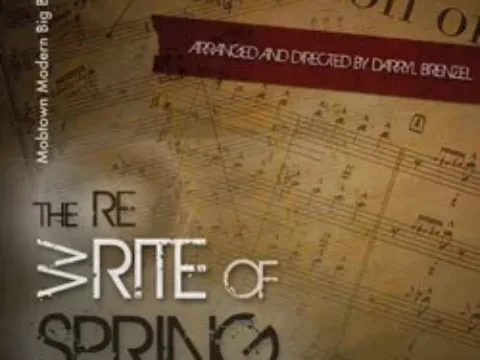
As the Rite of Spring approaches 100 years of public life, interest in Stravinsky’s masterpiece is set to increase, along with new ways of engaging with this infamous ballet score. There have been at least two Jazz-ifications of the Rite of Spring in recent months. The Bad Plus have been touring a live Jazz Trio version and Darryl Brenzel with the Mobtown Modern Big Band have released this ‘Rewrite of Spring’ on the Innova label.
First off, there is some stunning playing here, as well as very accomplished arranging by someone with a fine ear and knowledge of the score. Brenzel knows how to write for Big Band. The live recording is crisp and the balance is great. For me, the key issue here is the relationship between the two traditions of Big Band and the Classical Avant-Garde. What does the original piece gain from this treatment, and how do Stravinsky’s ideas influence this genre?
I have often thought that Jazz has suffered from failing to match astonishing achievements in harmonic and rhythmic innovation with structural imagination, i.e. breaking away from the ‘Head – Solos – Head’ format. In their version The Bad Plus keep pretty faithfully to the through-composed structures of Stravinsky and use their restricted palette to heighten the brutal intensity of the original. Brenzel approaches the task in the opposite way. His Rewrite embraces the varieties of colour afforded by a large ensemble. He also rethinks the structure as a more traditional Big Band format: A series of separate numbers showcasing soloists and allowing applause after each piece. While the applause reminds us of the live nature of this recording, it unfortunately sounds like the audience is small and far away. Brenzel chooses to keep to the ‘Theme (i.e. a block of the score) – Solo – Solo plus Backings – Theme’ structure for many of the tracks, homing in on suitable riffs, backings and underlying chord progressions. This has both advantages and disadvantages.

Darryl Brenzel
[Read more →]
Posted by Thomas Deneuville »
Add Comment »On Sunday, June 17 the 25th Bang on a Can Marathon took place at the World Financial Center’s Winter Garden…
For more videos, visit our Videos page or subscribe to our YouTube Channel!
Apologies to the acts that were not featured in this video. I (Thomas Deneuville) was also live blogging and taking pictures for I CARE IF YOU LISTEN. The post is here.
Embedding is cool. Crediting is really cool.
Video + Editing: Thomas Deneuville
Opening animation: Daniel Thompson at DTWebart (http://www.dtwebart.com)
© 2012 I CARE IF YOU LISTEN