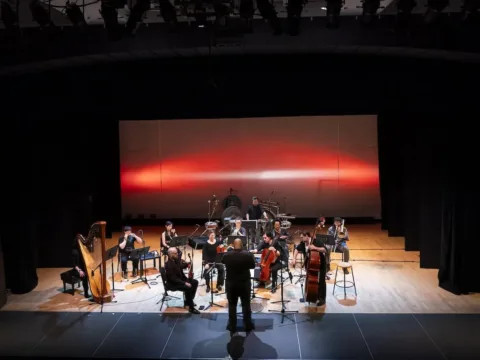
The recent 2012 Grammy awards highlighted the current trend in pop music towards the commercialization of authenticity: folk-rockers with horn sections, sincere hats, and loosely-pitched vocals largely won the day. I’ve noticed that this yearn for sincerity is also reflected in recent contemporary music created by 20- and 30-something composers in the Western classical tradition. Having no high-modernist clampdown against which to rebel, this generation seems largely free of the trickery of post-modernism. This bodes well for the future of art music: when a group of artists honestly explores the possibilities of their art form without devaluing what came before, a much larger variety of outcomes is possible. The opening weekend of the 2013 IMPULS music festival in Graz, Austria perfectly illustrated the value of composers who explore, with all sincerity, what music could sound like. On Saturday, February 9, 2013, the Helmut-List-Halle played host to an opening concert featuring four new works by young composers, commissioned by IMPULS, performed by Klangforum Wien under Enno Poppe. The next day, the composers engaged in an extensive panel discussion about the performance, giving the audience further insight into the concepts and contexts for their pieces.

The first piece of the evening, Matthias Kranebitter’s fröhliche Verunstaltungen (Musik als Neurose) (2012) (Cheerful Blemishes, Music as Neurosis), was troublesome. Kranebitter stated that his compositional concept for this piece was to juxtapose clichés from other styles of music from across the 20th century to form a carnivalistic theatricality. He hoped to throw the listener off her toes by having this group of world-class performers play with a messiness and spontaneity that reflected Kranebitter’s understanding of popular-music traditions as “grotesque, clichéd, and cheap.” The elements he used included: high piccolo lines that recalled marching-band music; fragments of drum-set work echoing various forms of popular music; violins sawing at potentially popular late-Romantic warbles; a moment that was almost, but not quite, a major-7-sharp-11 chord, as is frequently used at the end of almost every song from the big band swing era; and a long, repeated chord in the piano and percussion that conjured the American minimalists of the mid-twentieth century. The piece ended with the oboist standing up to play a solo, like a sax player in a jazz band. Unfortunately, these elements did not combine successfully to create either a post-modernist mashup or a re-interpretation of these genres. None of the musical-genre quotations were given enough weight to have any collective meaning, and theatrical elements felt poorly-conceived. Kranebitter’s condescending and uneducated impressions of popular music forms added no insight. Whether he was mocking or celebrating what he believes to be “dilettantism,” it was not a constructive aim; good art cannot arise from smarminess. Insincerity of this sort is a terrible waste of beautiful sonic possibilities.
The remaining three pieces on this concert demonstrated the success of the opposite compositional aim, to explore how new music can be built by focusing on the possibilities within a chosen concept. With this approach, the next three composers made interesting, if at times slightly static contributions to the weekend.

Each performer was placed on the stage as an individual island for Anna Mikhailova’s Bonus of Binary Balance (2012). It opened with a soundscape of plops and plunks: brass players slapping the mouthpieces of their instruments; the baritone sax player slap-tonguing; string players slapping their strings with their bows. Rhythmic motifs never joined players together, but repeated disjointedly through the ensemble. Occasionally, a pitched sound appeared in the piano and accordion. A nasal, sharp creaking sound repeated in the high strings. This soundscape broke several times, once for percussion interjections, once for an orchestral event. However, when the soundscape returned, there was little development, lending the piece a very static air. Mikhilova’s score for this piece was a complex conglomeration of words and signs that attempted to convey the final result of sounds without using conventional notation. The piece could benefit if the composer stepped back from this visual complexity to examine the sonic reality of the form and shape that arose from her visual creation.
The concept for irimi (2012) by Malin Bång arose from the set of movements used in the Japanese martial art Aikido. Working with the basic sounds created by the meeting of wood and metal, Bång recreated striking and chopping through both sounds and gestures. A percussion soloist, at the front of the orchestra, moved silently through disciplined and slow movements, which eventually led his hands to striking a sheet of wood and a sheet of metal. The string players then lifted their bows slowly, arms straight, before whisking them back down to create a unison “whoosh.” Other textures included metal rods used to strike the wooden side of string bows and breath sounds from the winds. When Bång opened the score up to improvisation based on this sound material, the piece lost some of the sense of discipline that had been building up, but this device also allowed for very interesting explorations on the fresh parameters she created.

The development of Æon (2012) by Daniel Fígols Cuevas reflected the composer’s background as a research scientist. Cuevas’ dense piece was the result of what he termed an experiment, to discover the result of an harmonic cloud with three separate layers. “I am always trying to get a new acoustic sound, where one cannot tell exactly which instruments are playing,” he explained, “like layering instruments to create a new molecule.” This piece blurred conventional sounds and extended techniques by mixing them together to form a new sonority. The results of the experiment were interesting, and definitely merit further exploration.
The biggest treat of the weekend was by far was Poppe and the Klangforum Wien. This group displays the utmost dedication and focus, bringing every resource at hand to perfectly realize the ideas brought forward by young composers. The trust this ensemble displays in younger artists is truly inspiring, and is a model of exactly the sort of authenticity and openness that allows for interesting music to thrive.
–
Caitlin Smith is a Canadian composer, currently based in Vienna. Follow her on Twitter: @tinyalligator.