Posted by Elias Blumm »
1 Comment »
On Joel Frederiksen’s Requiem for a Pink Moon, an Elizabethan Tribute to Nick Drake, selections from a 20th century English songsmith’s sadly truncated canon of music are set alongside that of forebears some 300 years his elder. Pink Moon, Drake’s final and most famous recording, clocks in at under a half hour, yet its realm of influence includes musicians from Robert Smith to Lou Barlow to Mikael Åkerfeldt, and even to the likes of Frederiksen, a bass singer and lutenist who has made a career expertly performing Elizabethan and early baroque music. And while the purest of Drake fans may find themselves irked by how his music sounds in the hands of classically trained period musicians (fans of period music may feel similarly about uncharacteristic 20th century British-folk elements) the record’s beauty lays in the way the songs of each party are left to sit and gaze at one another, elucidating music that seemingly has no business being in the same lineup.

Ensemble Phoenix Munich – Photo Thomas Zwillinger
[Read more →]
Posted by Elias Blumm »
Add Comment »“They will not let me off till I go with them, respond to them…”
In the poem “I Sing the Body Electric” from his masterpiece Leaves of Grass, Walt Whitman ruminates on humanity, the love he consents to accept, and the love he is willing to give. In the context of Duo Orfeo’s newest record, I sing the body electric, the meaning of those words broadens to include an artistic longing, one that drove two musicians to apply an inspired spark of originality to “go with” and “respond to” music that called to them but had hitherto been evasive and inadequate on their chosen instruments. For Joe Ricker and Jamie Balmer, two of a crop of young, classically trained guitarists who are finding new means of expression through finely honed technique, I sing the body electric is a milestone record that encompasses their pedigree and their passion in a completely original and captivating way.

Duo Orfeo (Joseph Ricker and Jamie Balmer) - Photo by Tristan Chambers
[Read more →]
Posted by Elias Blumm »
2 Comments »
Classical guitar is a pain in the ass. The way you’re meant to sit: weird/humiliating. The disparity between left and right hand technique: completely frustrating. Reading guitar music at sight: laughably annoying. And, perhaps most maddening: trying to project to a point at which an audience can actually hear you once you get all those other things to jibe. Maybe these reasons are why the instrument is so often neglected in the realm of chamber music, and furthermore, maybe that’s why there’s such a preciously tiny handful of classical guitarists that have broken the boundary into composition and true musicianship – because so few of us have the facility to deal with our own instrument, let alone communicate with or through other ones. That is why seeing David Leisner perform alongside pianist and compadre Jon Klibonoff as part of Symphony Space’s Guitar Plus series marked, for me, a kind of breakthrough. Apart from Leisner’s amazing facility that showed the guitar can definitely hang with arguably the most important instrument in the history of western music, his original composition for piano solo proved that classical guitarists can be legitimate musical thinkers with the ability to range out of the cramped knot that is them and their instrument and into a world of sound and color that points towards totally new directions.

David Leisner – Photo by Lisa-Marie Mazzucco
[Read more →]
Posted by Elias Blumm »
1 Comment »
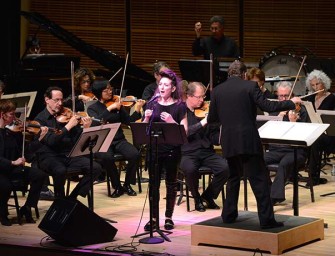
Ask a fan of The Mountain Goats what they listen for in the music of John Darnielle and there’s a very good chance their first answer will be words – inventive, potent words that bud to life and stamp their impression on the mind in tune after each brief tune. Ask a fan of Anonymous 4 what they listen for and words might come in 3rd, 4th, maybe 17th on a list of countless wonderful things about them. It has nothing to do with diction or delivery, but rather that the texts performed by Anonymous 4 are part of the cipher that makes their sound so eternal and mysteriously gorgeous; a sonic glimpse into the medieval past that, apart from those of us who happen to be Latin scholars or Capuchin monks, is satisfyingly inscrutable.
It’s no wonder they’re called Anonymous 4, Anonymous IV being the eponymous mystery man whose 13th century treatise on some of the earliest known European composers gives scholars and other folks who nerd out on musical antiquity, the clearest vision of polyphony as it was performed three quarters of a millennium ago. So, words, from the mouth of Darnielle: a comfortingly relatable substance, poetry that articulates the familiar in ways listeners may never have otherwise considered. Words from the mouths of Anonymous 4: a vehicle for some of the most celestial, tightly knit harmony this side of the cosmos. On Saturday, March 24, those words and those voices shared the stage at the Kaufman Center for the penultimate performance of the Ecstatic Music Festival.

John Darnielle, Anonymous 4, Owen Pallett – Photo by David Andrako
[Read more →]
Posted by Elias Blumm »
1 Comment »
The Norman S. Benzaquen Hall at the DiMenna Center for Classical Music has the appearance of a spruced up practice room, a tall, raw space with instruments piled in the corner. This was no less effective of an environment for Hotel Elefant, a group overflowing with young, dedicated musicians (seventeen in all) who have banded together in order to—as their press kit affirms—interpret the music of “innovative, living composers.” There is something in the collaborative camaraderie within the group, despite its largesse, that speaks to the delight each member takes up in this goal, and in that way the charm of the hall only added to the affect: a bunch of crazy kids lovingly playing a bunch of crazy music, some of it written from within the clique, all of it sounding totally personal in their hands.

Meg Zervoulis conducting Ung’s … still life after death
[Read more →]
Posted by Elias Blumm »
2 Comments »
In a museum, 1,000 years from now, beside the wing of long extinct animals that contains the taxidermied visages of the African elephant and Rush Limbaugh, will stand the Hall of Ancient Musical Instruments. It’s there that one will find the harmonium, slide whistle, Keytar, and (fingers crossed) various auto-tuning devices. And perhaps, however difficult it is to imagine the music scene of the future bereft of guitars, that old instrument will be there too, sitting beside the lute, which in the year 3012 will still be old as hell. In our present musical universe, the lute is rarely taken out of its glass case and dusted off for performance in easy to find places. Enter Jozef van Wissem, a self-proclaimed champion of the lute in the 21st century, whose artistic bio reads like the mission statement of “Lute Liberation.” That mission landed at Le Poisson Rouge on Monday March 5, 2012, in the form of an unlikely partnership between van Wissem and indie director-cum-guitarist Jim Jarmusch.

Jozef van Wissem and Jim Jarmusch – Photo by Sara Driver
[Read more →]