Posts Tagged ‘art’

31
May

5 questions to Eli Keszler (composer, artist and multi-instrumentalist)

Can you tell us more about your new piece, L-Carrier, that premieres on June 7 at Eyebeam?

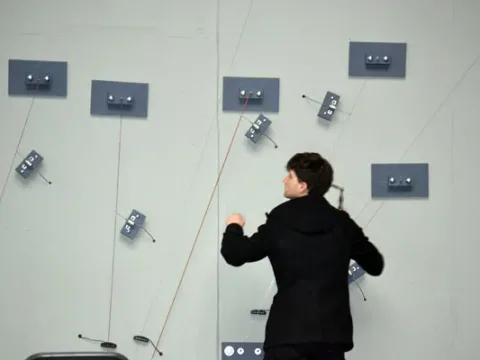
I’m really excited to be putting this new piece up. It will be running for 2 weeks, June 7 – 23, with an octet playing as part of the opening. The installation component is large-scale, using extended strings ranging in length from 3 to about 70 feet long going across the space, overlapping and twisting around each other installed into the two-story high ceiling. The strings are struck by motorized beaters, which are run by a mechanical micro-controller system. Also, solenoids will be scattered around the space, which will make percussive attacks and crisp sounds in contrast to the harmonic sustain from the tuned strings.

The piece is built using an intertwined feedback system, which is based on a portfolio of images that are reordering and moving on a remote website. These images trigger patterns in the installation’s mechanical system. When people view the website, it sends information to the installation as to how to work the patterns. The system begins with a security camera close up on one of the strings triggering the start of the patterns (portfolio) on the website; in turn, it cues the motors to strike the strings. So in total, the strings are cuing the patterns, which are cuing the strings. The whole system is activated by itself. The site displaying the operating patterns, the surveillance video and an audio feed of the installation is hosted at turbulence.org starting June 7.

Eli Keszler performing Cold Pin

Eli Keszler performing Cold Pin

[Read more →]

5
Oct

5 Questions to Niels Shoe Meulman – Artist, Calligrapher

For people interested in the idea of craftsmanship in the 21st century, Niels Shoe Meulman is a dream come true. From graffiti legend in the 1980s, to designer and now artist—creator of Calligraffiti—his mastery of the brush, quill, etc. is absolutely breathtaking. On a trip to China, he agreed to answer 5 (well, really four) questions… but here’s a short trailer for you first.

Niels Shoe Meulman presents Calligraffiti

Emerson said: “Words are also actions, and actions are a kind of words.” What are you trying to accomplish through Calligraffiti? Do you feel that you have a “message”?

I think I don’t have a message. I just do what comes natural and try to stay away from politics. If you want to see a message in my work, it would be that words can deliver more that just a message. For instance, lets take the word message. If you would focus on that particular word –perhaps by writing it in big black letters on your wall– then the ‘idea’ of message comes to life. You will discover a more abstract, more personal meaning in the word. I guess it’s somewhat similar with poetry. But then, I don’t understand most poetry yet.

I’m also uncertain what ‘words are actions’ means but it’s true that words can contain power. I lectures and in my book I state the claim ‘A word is an image. This goes for my graffiti years, my design/advertising years and my recent paintings.

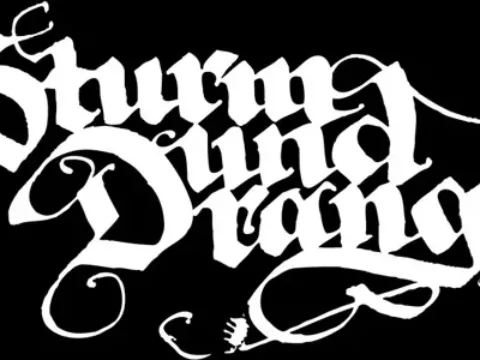
"Sturm und Drang" Vector art for exhibition with Metal Heart © 2011 Niels Shoe Meulman

Also, from the calligrapher’s point of view, the action of writing words is definitely a special moment. It might sound cliché but you must really have a free mind (Is that the same as an empty head? ahah) before you can attack the white paper with the black ink. It is a fearless balancing act between mind, hand, brush, ink and paper. Lovely.

I should also explain that ‘doing what comes natural’ doesn’t have to involve any tree hugging. I see evolution as something that never ends (and probably never began), it extends from what we call nature to modern day life. It’s the human condition of my time that is my ultimate inspiration. But I guess that goes for every artist.

If a message is an opinion, than the opposite of that opinion might also be interesting. If a message is a personal belief, don’t ram it down other people’s throat.

[Read more →]

5
Jun

5 questions to Dane Patterson (Visual Artist)

All the drawings that I’ve seen (over two different shows) seem to defy both time and balance and remind me of the work of Martin Klimas. Klimas uses photography, but how do you capture these moments with such a “slow” medium as drawing?

My drawings actually begin as photographs so photography is an integral part of my process. Drawing is slow, my drawings in particular, and that slowness in some way works to negate the photographic aspect of the images. I like to think of my drawings as having a spontaneous appearance, even though the process is slow.Before you asked the question, I wasn’t familiar with Klimas’s work. Most of his images capture an extremely brief moment – a glass vase shattering, or a bird in flight –something that we couldn’t savor with our eyes. It happens too quickly.

My images happen quickly too, though less so than Klimas’s, in the sense that what I ask of my models can be uncomfortable. They can’t maintain random stuff on their body or head for a long period of time, for example. Some of the objects are placed precariously, and as I take the pictures, there’s a constant threat of everything toppling. It’s funny because I’m often asked whether I draw from life, and of course I don’t. I ask a lot of my models as it is.

untitled

untitled - Graphite on Paper - 21.5 x 13 2010

The contrast and the textures that you achieve on your graphite on paper drawings are incredible. What makes depicting reality so attractive to you?

As much as I use a very realistic style – I aim for photo-realism in my drawings – I don’t actually consider what I depict to be reality. They aren’t documentary images, for example, but drawings of staged portraits or situations.

A couple of years ago I made a series of drawings of rooms with furniture and objects in disarray. These drawings look like a glimpse of a crime scene, but actually, I meticulously arranged the rooms in this way prior to shooting the photos, so again, it may look like reality, but it’s all staged. In most of my older drawings, it was important to me that the image depicted be a kind of record of a real event, a record of something acted out, for example. I used to like to think about my work as recording a performance of some type, and then, I probably would have like to think of myself as depicting reality. Now, though, I’m less concerned about that.

My attraction to photo-realism is firstly based on a desire to represent specific people, objects or situations, so I try very hard to be as detailed as possible. I’m more interested in the image rather than the fact of its being a drawing. I’d like the drawing to be a window of sorts, as much as it can be, and this means detail. This has meant that as I move forward, my drawings have grown in size so that I am more able to get that detail. I also just really enjoy drawing skin and textures. I love little bits of cardboard and folds of fabric.

untitled

untitled - Graphite on Paper - 20.25 x 32.25 2010

Your work also covers video and audio. Could you tell me more about vs. The New You?

“vs. The New You” is a sound project I did in 2005 with a friend, Ted Reiderer, and his band, The New You. When I started that project I was working on a series of home recordings under the name Deadpan Portraits of Local Notables. At that point I had gotten into very repetitive habits in my song writing, sticking to the same structures, and so on. So the initial concept for “vs. The New You” was to structure a group of songs around a pattern someone else had set for me.

When I was considering this, I happened to learn that Ted would be recording in the studio the following weekend, and I asked him to record a short segment of drumming, about one or two minutes. He brought this to his band mates who each agreed to record a short bit of drumming as well. They could do this in whatever way they wanted, and not all of them have a lot of drumming experience. I later created the remainder of the songs through multi-track recording using each of their contributions as a guide. So it was collaboration between me and each one of the four members of The New You, but what I like about it is the kind of after-the-fact quality of the collaboration.

This project actually helped me get away from my own style of song writing. After this was completed, I found myself more able to experiment in songs that I would write on my own.

The music you composed is really refreshing and surprising, building on the spontaneity of these four musicians who had no clue (I assume?) of what you were going to do with these recordings. What were you trying to achieve?

One goal was to expand my own songwriting, but I’m also interested in musical compositions that blend spontaneity with fixed instructions of one kind or another. When I first moved to New York City, I would see John Zorn’s “Cobra” performed whenever I could. “Cobra” is a game piece where Zorn conducts a group of musicians by holding up various objects – shapes, numbers, letters, etc. – and although each object carries certain instructions, the piece has a crazy energy that I’ve always wanted to try to capture on my own. “vs. The New You” gave me a bit of that because what I had to work with from each of the four band members was fixed; their drumming became the instructions or the backbones of those pieces, and I matched their choppy rhythms with quick sounds from a variety of instruments.

During our conversation you mentioned pieces you’re working on at the moment that require you to blend digital and “analog” visual arts (I mean taking pictures of you and working on them in Photoshop…). What is your process and (snare drums—signature question) are you concerned with a possible loss of craftsmanship because of technology?

As far as my process for these recent images, I begin with a pretty solid picture that conveys already most of what I want to include in the finished drawing. If there’s an occasion when a photograph lacks something compositionally, I have lately been editing in, or adding elements to balance out the picture. So in one image, for example, I had a seated model covered with a few objects, but later, I felt that it lacked intensity. I found a picture of flexible air duct tubing online and added it in, placing it on the model’s lap in the picture. In the finished drawing, it’s very difficult to tell that this has been added digitally.

If the final product of these images were photographs rather than drawings, I might feel less strong about them. The use of digital enhancement or additions would be less desirable for me if I thought of them as photographs.Since the images become drawings, though, I consider the digital additions to be on par with the actual objects that I put on the model. Perhaps this comes back to your earlier question about depicting reality. I’m not uncomfortable with editing in Photoshop and I don’t at all think there’s a loss because my drawings don’t depict a reality that exists apart from my intervention.

Related Links:
www.danepatterson.com (Dane’s main website)
www.deadpanportraitsoflocalnotables.com (a separate website for this ongoing project
www.plantmigrationrecords.com (Dane’s record label)