Posts Tagged ‘Cantaloupe Music’

22
Dec

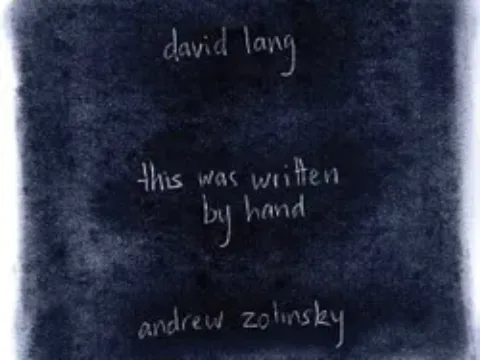
David Lang’s this was written by hand – Meditations on Memory

On his new album from Cantaloupe Music, this was written by hand, David Lang treats the piano alternately as a eulogizer and as a medium to commune with the departed. Pianist Andrew Zolinsky’s technique is well suited to tastefully render these finely wrought improvisatory pieces, to sound out the meditative character of Lang’s postminimalism. The range of piano articulation presented here stretches from use of the instrument as pitched percussion all the way to liquid, dulcet burbles. Piano music in the contemporary classical world often embraces jazz tropes, or world music idioms, or past stylistic genres. Lang’s piano voice sometimes recalls the phase music of Reich but is for the most part quite original in its complete metrical flexibility (or complete lack of meter in some cases, it seems), and in the way it exhaustively explores all the possibilities of a spare musical form. The tracks here are all character pieces in my opinion. There are no grand statements; on the contrary, the prevailing voice is one of personal introspection, without a hint of sentimentality.

David Lang

[Read more →]

14
Dec

Florent Ghys, phase à la française on Cantaloupe

Earlier this Fall, Cantaloupe (the record label created 10 years ago by the founders of Bang on a Can) released Florent Ghys’s first LP, Baroque Tardif, following a 2009 EP, Baroque Tardif: Soli. Born in France, Ghys is a composer, double bass player, and prolific videographer.

The title of the album (meaning late Baroque in French) is a tongue-in-cheek reference to a wacky guitar teacher that Ghys’s studied with as a teenager, and who was convinced that Baroque music would come back one day and rule other genres (#Barmageddon… discuss). The overall vibe, though, is DIY Post-Minimalism infused with a heavy dose of 21st century counterpoint.

The album opens with Phase Parisienne and Ghys starts by building counterpoint patterns on the bowed double bass in an additive fashion—layer by layer. They point, at first, towards Reich’s processes but soon haunting harmonics accompanied by hand clapping make the piece almost sound like some minimalist Gnawa music. Awesome. The following track Pull Blanc, Chemise Rouge (White Sweater, Red button-down shirt) introduces another element of Ghys’s very personal idiom: syllables as musical objects. Ghys sings dislocated modal melodies in solfège syllables (fixed do) with a thin voice and each note thus named loses its anonymity, and is treated as a found object. Or maybe is it a reference to the virtuosic practice on the Indian subcontinent to sing complex and improvised melodies on Swaras? Ghys has after all—and among many others—a degree in ethno-musicology…

[Read more →]

10
Nov

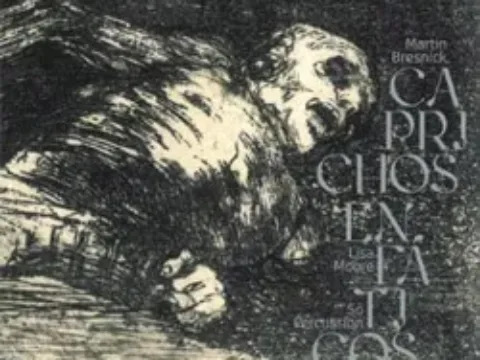
Lisa Moore & Sō Percussion: Martin Bresnick’s “Caprichos Enfáticos” on Cantaloupe

Francisco Goya’s famous series of prints Los Desastres de la Guerra (The Disasters of War) were created between 1810 and 1820, though not actually published until 35 years after Goya’s death, in 1863.  There are 82 prints in all, each highly critical of both Spanish and French rulers during the conflicts between the two countries in the early 19th century, and they are shockingly graphic: realistic depictions of mutilated corpses in the aftermath of battle and the effects of famine, and gross mockeries of the ruling classes and the clergy.  They are less high art and more a sort of proto-photojournalism.

Martin Bresnick’s Caprichos Enfáticos: Los Desastres de la Guerra, an 8-movement concerto for pianist Lisa Moore and Sō Percussion, begins with, of all things, a farandole/farándula––a popular, jaunty 6/8 chain dance.  In live performance, Lisa Moore plays the opening line of the farandúla on xylophone, alone on stage.  A percussionist enters behind her and seamlessly takes over the line, and Moore continues to the second line.  A second percussionist enters, taking over the first line, and the first percussionist moves to the second line, and Moore moves to the next layer, etc.  It’s torturous to try and describe the effect in words, especially since it’s been three years since I saw it live at the 2008 Canberra International Music Festival in Australia, but it really does look and feel like a musical chain dance.  It’s also just really cool to watch Lisa Moore play toms.

[Read more →]

19
Oct

Lightning Slingers and Dead Ringers by Lisa Moore on Cantaloupe

The titular composition of Lisa Moore’s new EP, composed in 2008, refers to a telegraph operator.  The metaphor is apt, as the piece is heavily charged with energy currents both active and awaited.  Moore performs the three tracks of Lightning Slingers and Dead Ringers on a keyboard controlling the Native Instruments Kontakt sampler, while simultaneously playing a Steinway D, producing an engaging industrial process balanced with a wide range of expressive piano timbres.  The sampler is well adjusted to produce raw, sine and sawtooth-like sounds more reminiscent of oscillators from the early days of electronic music.  The first track, “With enthusiasm and a little violence,” opens with an assault from the sampler outlining a stark tonic – dominant – tonic loop.  The piano joins in with ominous trills and accented dissonant chords, and the keyboard triggers samples of prepared piano, plucked in such a way as to evoke the sound of an Oriental zither. Digital blips begin to pepper the texture, as if Kraftwerk plays pinball nearby. The sampler’s abstract loop fades out so that piano voices can be explored more fully, combining samples of extended techniques (strumming, etc.) with standard live playing.  Annie Gosfield [the composer - Editor's Note] eschews the dense tone clusters of many contemporary composers and employs a language of short frenetic melodies and simple pitch sets, placed freely in time, so that the piano speaks and meditates, rather than singing.

[Read more →]