

Posts Tagged ‘inspiration’

5
Oct

5 Questions to Niels Shoe Meulman – Artist, Calligrapher

For people interested in the idea of craftsmanship in the 21st century, Niels Shoe Meulman is a dream come true. From graffiti legend in the 1980s, to designer and now artist—creator of Calligraffiti—his mastery of the brush, quill, etc. is absolutely breathtaking. On a trip to China, he agreed to answer 5 (well, really four) questions… but here’s a short trailer for you first.

Niels Shoe Meulman presents Calligraffiti

Emerson said: “Words are also actions, and actions are a kind of words.” What are you trying to accomplish through Calligraffiti? Do you feel that you have a “message”?

I think I don’t have a message. I just do what comes natural and try to stay away from politics. If you want to see a message in my work, it would be that words can deliver more that just a message. For instance, lets take the word message. If you would focus on that particular word –perhaps by writing it in big black letters on your wall– then the ‘idea’ of message comes to life. You will discover a more abstract, more personal meaning in the word. I guess it’s somewhat similar with poetry. But then, I don’t understand most poetry yet.

I’m also uncertain what ‘words are actions’ means but it’s true that words can contain power. I lectures and in my book I state the claim ‘A word is an image. This goes for my graffiti years, my design/advertising years and my recent paintings.

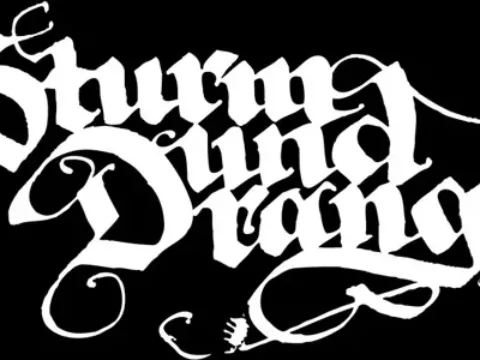
"Sturm und Drang" Vector art for exhibition with Metal Heart © 2011 Niels Shoe Meulman

Also, from the calligrapher’s point of view, the action of writing words is definitely a special moment. It might sound cliché but you must really have a free mind (Is that the same as an empty head? ahah) before you can attack the white paper with the black ink. It is a fearless balancing act between mind, hand, brush, ink and paper. Lovely.

I should also explain that ‘doing what comes natural’ doesn’t have to involve any tree hugging. I see evolution as something that never ends (and probably never began), it extends from what we call nature to modern day life. It’s the human condition of my time that is my ultimate inspiration. But I guess that goes for every artist.

If a message is an opinion, than the opposite of that opinion might also be interesting. If a message is a personal belief, don’t ram it down other people’s throat.

[Read more →]

11
Jul

5 questions to Bonnie Montgomery (Composer)

I recently went to a performance of Billy Blythe, an opera by Bonnie Montgomery and Britt Barber that had its full premiere by the Metropolis Opera Project at the Medicine Show Theatre on June 19 and 20 in New York.

Billy Blythe, a short-length opera in one act, is a coming of age story set in the late 1950′s in Hot Springs, Arkansas. The work is a snapshot of Arkansas life and how the character, culture and landscape of southern Arkansas shaped the adolescence of former president Bill Clinton. The work’s name comes simply from Clinton’s birth name, which he changed at age sixteen.

The opera garnered some nice press here, here, here or here and I decided to interview Bonnie Montgomery for a short feature on this blog. It turns out we have a dear Arkansan friend in common!

Bonnie-Montgomery

Is Billy Blythe your first venture into opera?

Yes, Billy Blythe is my first opera to compose, but I studied opera performance throughout my education. I love it very much, but growing up in rural Arkansas, I didn’t discover it until I was a teenager. I sang several roles through my college years, including Augusta in The Ballad of Baby Doe, which was my favorite role to play so far.

What were the dramatic elements that inspired you to turn Bill Clinton’s biography into a libretto?

Clinton My LifeBrittany Barber wrote all the words for Billy Blythe, and we both brainstormed on the content of the libretto. Clinton had a very colorful childhood with a lot of strong characters and dramatic scenes. We actually had to whittle down which of those to portray in the opera. Every character and major event in the opera came straight from Clinton’s autobiography, My Life and Virginia Clinton Kelley’s memoir, Leading With My Heart.

[Read more →]

27
Apr

5 questions to Katherine Knight (Painter)

Two weeks ago I was in Solomons, MD (my girlfriend had an art opening for a group show of portraits) where I met Katherine Knight, a Washington DC based painter. We started talking about craft and technology and she had to be interviewed on these pages…


During our conversation you mentioned using your iPhone in your creative process/practice. Can you tell me how? Do you consider getting an iPad?

It’s becoming a cliché, but I would say that my iPhone has completely changed my life; particularly the way I conduct research for my studio. Prior to the iPhone, my research tools consisted of my digital camera for taking reference photos, a sketchbook for studies and compositional ideas, my computer for internet research and Photoshop (which I’d use to compose some of the more complicated paintings), a Wacom tablet and drawing stylus, color media (watercolor, gouache, or acrylic paint) for color studies, and various different types of paper for specific tasks. Now I can do all of that on my iPhone. I’ve given up a little in quality- the camera is not as good, and the drawings are a bit clumsy, but it’s certainly sufficient for research, and I’ve gained so much in flexibility. Plus I think the technology is only going to improve. I don’t have to carry as much stuff around with me anymore, and I spend a lot less time at my desk. Before, I would have to consciously put on my Artist Hat. I’d have to think ‘I’m going to the zoo today, better take the camera in case I see something I want to use’. The iPhone is with me all the time, and allows me to easily take my research with me wherever I go, without forethought.  I never used to be one of those artists doing sketches all the time out in public. What interests me most is color, and it’s quite a hassle (and sometimes prohibitively messy) to carry color media around with you- even if it’s only colored pencils. The very first thing I did with my iPhone was download a drawing app (ArtStudio), and now I can do color studies absolutely anywhere. I’ve drawn on the Metro between stops, in the car on road-trips, in class while my students are working, even at night in the dark. I can work in full color in museums, directly in front of the paintings- it’s amazing. I’m becoming much more fluent with color, which is helpful when I’m back in front of my easel.

As for the iPad, I caved! My husband and I just bought one to share (which is difficult, but we’re managing). It is a MUCH more advanced machine, and having the bigger screen makes it much easier to work with. But because of its size it’s still not quite as spontaneous as the iPhone. I’m looking forward to having it in class, in museums, and on trips. Ultimately I think it will be nice to have both.


[Read more →]

24
Mar

5 questions to Jason Gerraughty (Composer)

As a composer, are you inspired by other art forms? If so which ones?

I’m inspired a great deal by other art forms. In my undergrad at Hartt, I used to log in as many hours at the Wadsworth Atheneum as I did in the concert hall. A particularly inspirational piece for me was Rauschenberg’s Retroactive I, which got me to start experimenting with fragmentation and “found” musical ideas. Lately, I’ve been revisiting Klimt and Schiele’s work, having tied in with a piece I wrote for wind ensemble and electronics, TWEAK.

Do you use a computer for your work? When did you start?

I have a love/hate relationship with computers and music making. I use a computer for notation and the like, but haven’t really been able to get over the hump toward using electronics as a medium until very recently, maybe only three years ago. That said, I believe that I was in the wrong in my attitude that a composer could ignore the influence of computer technology in composition. Considering how ubiquitous computers are in our society (this is a blog interview, right?), how could they not affect the art that we make?

J. M. Gerraughty

J. M. Gerraughty

Do you still use paper? What for?

I do still use paper and pencil (I bought a fancy pencil and named it Excalibur. Dont’ laugh, it’s a nice pencil!), but mostly for sketches and scratch scores. I don’t intend for people to look at my manuscripts, so I don’t keep track of them or anything. Even if people saw them, they’re mostly scribbles anyway. My process is to sketch on paper, then put my finished ideas into Finale.

Does working on a computer affect the way you compose?

I think that working with a computer affects the way we compose, for certain. I recently took an interview for a PhD program, and one of the first questions out of their mouths was “do you use the Playback Button?” I think it’s interesting that so much scandal surrounds this feature of notation software. As for using other programs, I definitely think that the way you make music with electronic software is much more akin to the process of creating visual art than traditional notation. There’s a lot more “play” involved, and a lot more experimentation, which is freeing, but can make you feel vulnerable. I find that MAX/MSP and similar programs really push the boundaries of music in many exciting directions, which I’m just beginning to explore.

Audio clip: Adobe Flash Player (version 9 or above) is required to play this audio clip. Download the latest version here. You also need to have JavaScript enabled in your browser.


Link to MP3 – J. M. Gerraughty – Slant of light

Are you concerned with a possible loss of craftsmanship because of technology?

With the advent of digital photography, there came a backlash. Older photographers hated the idea: it vastly democratized an already very democratic medium of photography, allowing many with no training at all to pick up a camera and start taking pictures. It undermined their years of darkroom experience. People didn’t have to concentrate on the shot as much because if they messed up, they could see it in the viewscreen and simply retake the shot. It watered down the public’s desire for high-quality film photography which digital photography still can’t match to this day. Still, more pro photographers use digital cameras today than film, even though they know that film is better.

“Craft” is an idea we use to make ourselves feel like we’ve earned some kind of legitimacy through years of study, that making art is somehow not as random and intuitive and inexplicable as we know it to be. Craft helps, but it’s not something I’m worried about losing when I choose to make my life a little bit easier.

J. M. Gerraughty (born 1982) in Nashua, NH, is a composer based out of Stony Brook, NY. His current projects include works for Johns Hopkins University and for hornist Lydia Van Dreel. He struggles with the piano every day. http://www.jmgerraughty.com

21
Mar

5 questions to Boris Pelcer (Illustrator/Designer)

As an artist/designer, are you inspired by other art forms? If so which ones?

Music is definitely my big inspiration, especially soulful house music. I love to look at anything that pushes the visual and conceptual boundaries of what is accepted or has been done, which includes photography, illustration, architecture and largely graphic design.

Boris Pelcer

Boris Pelcer

Do you use a computer for your work? When did you start?

I do use computer for my work and its usually there to quicken my process. I started using computer for art when I was 7, and of course that was for fun. I loved using Paint to draw Sonic the Hedgehog. However, I really got into into Photoshop in the junior year of high school.

Do you still use paper? What for?

I start all of my ideas on paper. The gestures I can capture with the use of paper and pencil is nothing that I can capture on computer even with the use of my tablet.
Boris Pelcer

Does working on a computer affect the way you create?

The results are much cleaner and it does not allow for the same gestural results as with the hand done drawings. Hence, that is why I start out everything on paper, and computer is there to clean it up for the final version.

Are you concerned with a possible loss of craftsmanship because of technology?

A lot of people may get absorbed by the technology use and forget the value of hand done art work. However I am certain many like myself will still continue to do everything by hand first and use technology as a tool to finalize a product into a digital format. In doing such I can capture the hand crafted look and use the power of technology to do it quickly, and with the power of Internet I communicate with my clients faster and market my work just as effectively. In addition those that continue to value and apply hand crafted art will certainly stand out.

Born in 1985 in Bosnia and Herzegovina, Sarajevo, I moved to U.S.A. in 1998 in search of better life. I recieved my B.F.A. in Illustration from Milwaukee Institute of Art & Design. Since I have worked as a freelance Designer/Illustrator, and full time Apparel Graphic Designer where I had the opportunity to work with great clients such as Urban Outfitters, Spencer’s, Zumiez, Hot Topic, Harley Davidson, Miller Brewing Co., Target & Kohl’s. I have also been awarded by SOCIETY OF ILLUSTRATORS and had work published in publications such as CMYK. Currently I am working on my MFA in Graphic Design and using that opportunity to push the boundries between Graphic Design, Typography & Illustration and merge the different disciplines closer together for innovative methods of visual expression. http://www.borispelcer.com

17
Mar

The Writing of a Cantata #3: text setting

I have been setting a lot of text to music recently, in order to finish the two song cycles that will be premiered on Sat. April 2nd at the Estonian House, in Manhattan. In parallel, I’m also setting the computer-generated poetry that I will use for my cantata, as well as a poem by Ella Wheeler Wilcox. All this to say that I’ve been in text setting mode for weeks now and I really enjoy the acute attention to text, pronunciation, meter, etc.

Back in December, Timo Andres wrote something really interesting on his blog:

One of the reasons most “art song” (for want of a better term) is unsatisfying to me is the dutiful teleology of it— here’s the poem, set it to music, and when you get to the end, you’re done. Poetic form is almost always different from musical form, and letting one dictate the other seems to me like a huge cop-out.

I can really see what he means, but it is currently what I find fascinating and relieving in text setting: the text provides another constraint (remember Igor? The more constraints one imposes, the more one frees one’s self…), and helps to shape the entire form of a song. Yes, it can seem like a huge cop-out, but for a less experienced composer this kind of suggestion of form is truly welcomed.

Beyond considerations of pure music writing, I am still very inspired by Peter Sellars’s approach to text/libretto:

“You collect all this material and at a certain moment passages start speaking with other passages, … A conversation that goes along with individual source material just takes off, and things start ricocheting and having surprising connections or counterbalances. You’re always looking for yin and yang so the drama thrives on contrasts and contradictions.”

This is what I tried to do at a microscopical level in my cantata, and will still try to do in the future (a postmodern drift?).

And for people that never dabbled at text setting, here is a sonnet by John Donne that was set both by Benjamin Britten and John Adams, 60 years apart. I like how different they sound and how differently they were read by the composers, and by read I mean that the text projected an entirely different sound image in the composer’s mind…

HOLY SONNETS.

XIV.

Batter my heart, three-person’d God ; for you
As yet but knock ; breathe, shine, and seek to mend ;
That I may rise, and stand, o’erthrow me, and bend
Your force, to break, blow, burn, and make me new.
I, like an usurp’d town, to another due,
Labour to admit you, but O, to no end.
Reason, your viceroy in me, me should defend,
But is captived, and proves weak or untrue.
Yet dearly I love you, and would be loved fain,
But am betroth’d unto your enemy ;
Divorce me, untie, or break that knot again,
Take me to you, imprison me, for I,
Except you enthrall me, never shall be free,
Nor ever chaste, except you ravish me.

Source:
Donne, John. Poems of John Donne. vol I.
E. K. Chambers, ed.
London: Lawrence & Bullen, 1896. 165.

Britten: Holy Sonnets of John Donne- "Batter my heart"

Britten: Holy Sonnets of John Donne -No.II ” Batter my heart” (1945)
Paul Austin Kelly, tenor
Michael Recchiuti, piano

"Batter, my heart", from Doctor Atomic

John Adams: Doctor Atomic, end of Act I, “Batter, my heart” (2005)
Gerald Finley, baritone

What does text setting mean for you? A cop-out? A chore? The only music you’d ever want to write? Feel free to react in the comments section, or find me on Twitter: @tonalfreak.

Next Page »