Posted by Danny Clay »
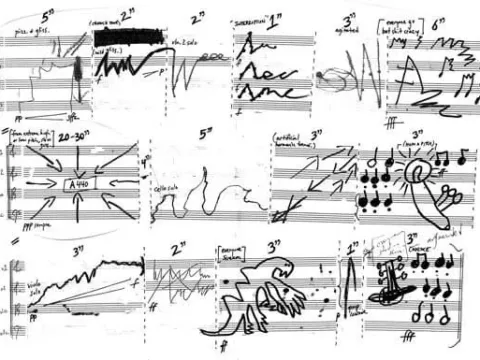
3 Comments » Kids, Graphic Scores, & How Music Education is a Two-Way StreetI suppose I should open with a disclaimer: I am a composer, by no means an expert on music education, and am not particularly well read in the area of pedagogy. I am writing this little article because, in the words of J.S. Bach (as paraphrased by Kyle Gann), “I had a gig.” And yet I would have never imagined that in the pursuit of writing an engaging tune for string quartet I could have stumbled across as much food for thought as I did. In short, my search for a good 3-minute piece culminated not in the discovery of a snazzy riff or a harmonic progression that I found particularly cool but it came, instead, from a few notes by Beethoven and a room full of third graders.
[Read more →]
Posted by Thomas Deneuville »
2 Comments »With the 25th Bang on a Can (BOAC) Marathon taking place at the end of the week (Sunday, June 17—see the full program here) we thought that Evan Ziporyn would be a great candidate for a 5-question interview. He kindly took the time to answer them and shared much more than we could have hoped…
You’ve been part of the BOAC Marathon since its first installment in 1987, in the Exit Art Gallery in Soho. How did you end up playing this gig at the time and how was it?
I’d been working with Michael Gordon since 1980, we met backstage at a new music concert at Yale, where we had a ‘where have you been all my life’ moment after hearing each other’s music for the first time. And I’d done numerous projects with all of them throughout the 80s, including the pre-Bang “Composers Banging on Cans” concert at Cooper-Hewitt Museum in 1986. By then I had moved to the west coast but had kept in close contact with them all, I’d fly back to play with Michael’s band, etc. This wasn’t hard because we only had about 3 concerts a year…
Also, as you probably know, the idea of the marathon came from Martin Bresnick’s Sheep’s Clothing ensemble at Yale, which did an annual all-night concert in the late 70s and early 80s. Martin went on leave in 1980, I ran the group in his absence, and Michael came to all the concerts – after that David [Lang] arrived in New Haven and also became very active in that group – so we all were aware of the benefits of marathon concerts.
Still, that first Bang marathon was memorable to me for a number of reasons – a lot of my heroes were there, Reich & Cage & Milton Babbitt – it was amazing to me to be in the same room with them, let alone on a program with them. I met Robert Black there, he performed immediately before me, and of course I’m still working with him in the All-stars now. And I’ll always remember Babbitt speaking before his piece, saying “I’m sorry I got here late, but I got lost – I’ve never been this far downtown before!”

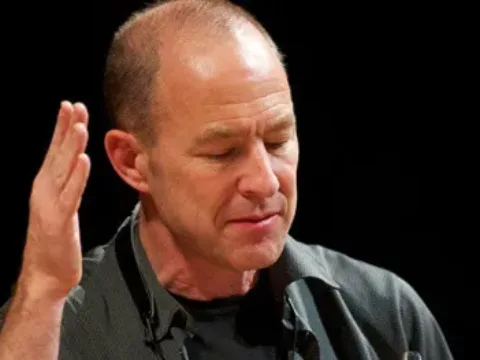
Evan Ziporyn - Photo by Andy Ryan
[Read more →]
Posted by Andrew Lee »
9 Comments »I am not a governess who treats the composer like a child and tells him what he should compose. I try to understand what he has written down. I look at the composer like a father, and I look at his music with loving but critical eyes.
- Alfred Brendel, 13 September 2005, Interview with NPR
As an undergraduate, I had a great deal of admiration for Mr. Brendel. In his writings and recordings he seemed to uphold the ideal that the performer is in service to the score and composer, and must do his or her best to faithfully transmit the music to the audience. The opposite of this approach is the selfish performer, who believes that he or she knows better than the composer how to best bring the music to life. Such performers upstage the composer and do so without any compunction.
Of course, it doesn’t take long to realize that it would take sort of some sort of spiritual possession for a performer to be a a perfect conduit of the composer’s intentions (and I don’t quite think that’s Brendel’s ideal). But what really brought me away from Brendel’s line of thinking was a discussion on creativity in grad school.

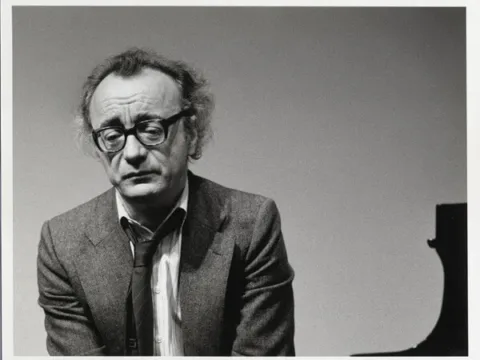
Alfred Brendel - Photo by Betty Freeman
[Read more →]