Posts Tagged ‘London Sinfonietta’

26
Dec

London Sinfonietta New Music Show 3 at Southbank Centre

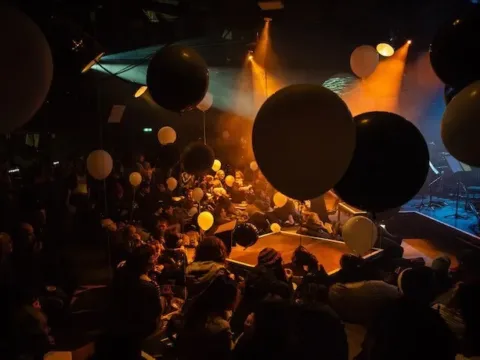
Southbank CentreSituated on the edge of the River Thames, The Queen Elizabeth Hall at Southbank Centre was the site of New Music Show 3, presented by London Sinfonietta on Saturday, December 2, 2012. Standing in the main foyer before the performances began, it felt like being in a reverse greenhouse, looking out over the illuminated city lights and the winter market below as musicians graced the stage for the first time. The small space was packed with a jostling demographic: from suited business types occupying leather sofas to small children sitting opposite, falling asleep on their grandparent’s knees. A mere look around the room already indicated a degree of success in bringing contemporary classical music to a wide range of listeners, one of the Sinfonietta’s primary objectives.

London Sinfonietta (photo credit: Southbank Centre)

[Read more →]

30
Jan

Posing Questions: Wolfgang Rihm at 60

Southbank Centre2012 sees the 60th birthday of the prolific composer Wolfgang Rihm and the London Sinfonietta curated a concert that included three UK premieres of Rihm works in addition to two works by composers who at some point in their training were taught by Rihm: Rebecca Saunders and Jörg Widmann.

Wolfgang Rihm - Photograph by A.T Schaefer

[Read more →]

10
Jan

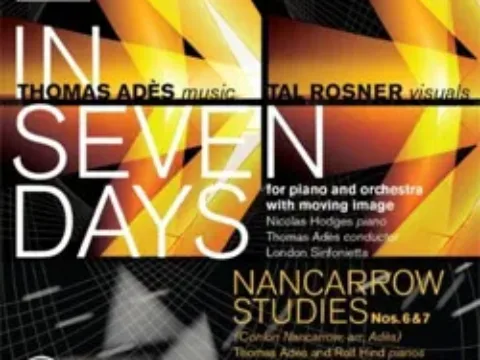
Thomas Adès: In Seven Days (London Sinfonietta/Signum Records)

A fascinating new release from Signum Classics, and the second with the London Sinfonietta, is In Seven Days by the British composer Thomas Adès (b. 1971), alongside arrangements by Adès of two Nancarrow studies for two pianos.  In Seven Days is a work for piano and orchestra with moving image (created by Tal Rosner) and was jointly commissioned by the Southbank Centre and the Los Angeles Philharmonic and first performed in 2008. It tells the story of creation but returns to the Hebrew version and it is certainly compelling to hear the composer and creator of the visuals Rosner discuss the work in conversation on the DVD, along with performances of the works with the visuals.

Thomas Adès – Photo by Maurice Foxall

[Read more →]

21
Nov

Written/Unwritten: London Sinfonietta @ Purcell Room, Southbank Centre, London

Southbank CentreI’m always keen to hear concerts that attempt to fuse genres and London Sinfonietta’s Written/Unwritten concert at the Purcell Room – as part of the London Jazz Festival – did just that. It brought together players from the ensemble with two jazz musicians – pianist Matthew Bourne and jazz percussionist Vladimir Tarasov. The programme is prefaced by an introduction to the concept of this Written/Unwritten event – “What happens when you give a group of musicians the chance to write their own music? … What happens if you put classical and non-classical musicians in a room together for several days and ask them to explore, create and produce music a concert at the Southbank Centre? Find out tonight …”

Matthew Bourne – Photo by Briony Campbell

[Read more →]

4
Oct

London Sinfonietta and Boulez – South Bank, London

Southbank Centre

Exquisite Labyrinth series: The music of Pierre Boulez / Saturday October 1st 2011

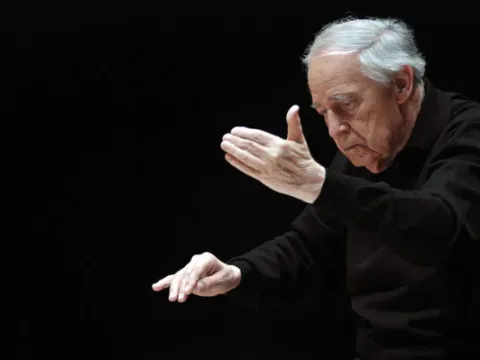
There was something of a special occasion on Saturday night at the Queen Elizabeth Hall on London’s South Bank. The concert formed part of a weekend celebrating the work of Pierre Boulez, whose presence at the concert was welcomed as was his conversation with Pierre Laurent-Aimard that preceded the first performance; this was enlightening not only about the works we were about to hear but also about his compositional approach. He is wonderfully articulate about his practice and at the same time humour was never far from the surface – relating the experience of the listener to that of a tennis match spectator, with the constant head movement amused the audience. Boulez described his polyphony as the interplay of the live timbres and their interaction with electronics; the conversation did a great deal to help clarify not only his approach to the interplay of live and electronic timbres but helped understand the works that were to follow.

© A. Warmé-Janville


Clio Gould gave a masterful performance of Anthème 2 – for violin and electronics.  Anthème 2 is an expanded and revised version of  Anthème 1 (1991, for solo violin) and was produced on 1997.  Clio played from the score which was setup with real aplomb by a member of the backstage team on several music stands; his efforts were recognised with applause before Clio appeared on the stage. This was my first hearing of the work and her consummate musicianship displayed real control of the structure of the work through delicately controlled playing throughout. The electronics were controlled with precision and worked with the acoustics of the hall well. Boulez talked about the ‘polyphony’ created through the use of electronics to explode the material of the violin solo in his pre-concert conversation and this was helpful in understanding the nature of this fascinating work. There were moments of harmonically stable sustained notes which contrasted beautifully with the surrounding material, and the consonance of some of these moments was particularly striking at times. The dimmed lighting near the plaintive close of the work seemed completely natural and the work ended in a black out.


…Explosante-fixe… demonstrated the immeasurable virtuosity of the London Sinfonietta under the calm and controlled direction of Péter Eötvös. The version performed was the last produced between 1991 and 1993 while Boulez was at IRCAM, and it forms the final version of a work that has been revised on numerous occasions for different forces since its conception in the year of Stravinsky’s death in 1971. The three spatially separate and amplified flautists – one the solo and the other ‘shadow’ flutes – were particularly accomplished; Michael Cox’s playing was fantastically virtuosic and with a beautiful yet powerful sound. The electronics were sensitively balanced and blended with the live timbres with precision – moments of electronics only were signalled by dimming of the lights. Eötvös showed that this is a masterpiece of musical construction and through his direction we were able to shift attention between the various timbres featured in the work with clarity. The London Sinfonietta’s performance was engaging throughout. The two works presented were programmed very well and along with the pre-concert conversation between Boulez and Aimard, one was able to hear why Boulez is appropriately considered one of the greatest musicians of the 20th and 21st century.


Steven Berryman is a composer and teacher working and living in London. He is currently completing his PhD in Composition at Cardiff University (2011). Follow him on Twitter: @Steven_Berryman