Posted by David Pearson »
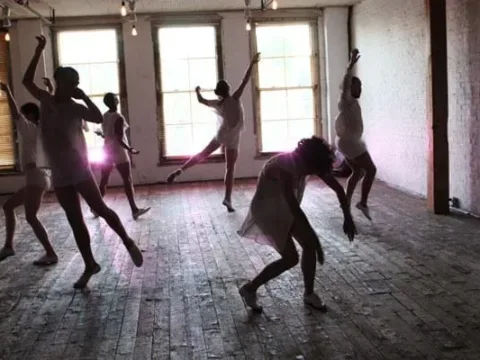
2 Comments »On June 13-15, 2013, Rebecca Lazier and her performers will team up with Newspeak to present the NY premiere of Coming Together/Attica, an immersive, site-specific dance work to Frederic Rzewski’s iconic scores at The Invisible Dog Art Center. We asked 5 questions to Rebecca about this project.
How, for you, does Rzewski’s Coming Together / Attica speak to the present?
When I first heard Coming Together and Attica – a friend sat me down, gave me headphones and told me to listen – it was entirely without context. I was unaware of when it was composed, the source of the texts, the performer instructions, the compositional techniques, the significance of the riots in American history or of Rzewski’s controversial position in the music world. Despite my naiveté, I was immediately struck by its combination of structural clarity and emotional power. I wanted to know how it was made, what made it work and who Frederic Rzewski was.
As I learned about the history, context and structure of the piece, I noticed that while knowing more allowed me to appreciate the work and see it as an artistic challenge, the piece resonated with present-day compositional methods and provided insight into disturbing current cultural policies. As I delved into it, I realized the music isn’t just about a single moment of American history, but a work that continues to shed light on relevant abstract and political questions. Although it was inspired by the riots, Rzewski does not dictate an ideology in the piece, he invites the listener to create his or her own meanings. This allows it to be timeless.
For me, the piece speaks to the present on several levels. Rzewski’s compositional approach to merge formal constraints with political content is used across art disciplines today. Performing the piece now can also raise consciousness of the current prison crisis in America. An unprecedented proportion of our population is incarcerated. The perverse lack of rehabilitation services and the use of isolation to treat symptomatic behavior is tantamount to a humanitarian disaster and demonstrates questionable educational, cultural and political policy.
Rzewski’s work brought new perspectives to my experience of isolation and confinement, introduced possibilities for structural invention, motivated me to research the historical and current conditions of imprisonment, and enabled me to imagine social change through art.

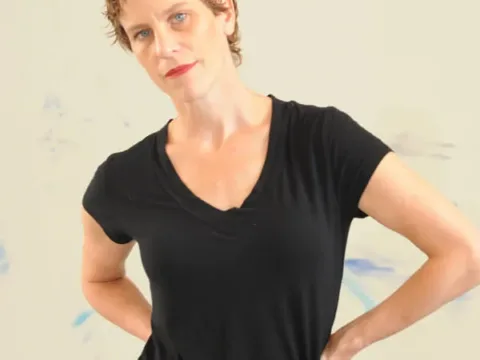
Rebecca Lazier – Photo by Bentley Drezner
[Read more →]
Posted by Daniel Kushner »
1 Comment »
I have uncles who fought in the Vietnam War, and I’ve never once talked to them about their wartime experiences. In fact, I grew up being actively discouraged from bringing up their service to the United States in conversation. But does this respectful yet evasive approach toward veterans aid us as citizens in understanding the sacrifices of war and those who readily made them?
Composer David T. Little’s hour-long 2006 opera Soldier Songs emphatically answers that question, and delves deeper still, with a narrative that follows the “every-soldier,” so to speak.

David T. Little – Photo by Merri Cyr
[Read more →]
Posted by Matt Mendez »
1 Comment »
Classical music and warfare have always been covert bedfellows. Mozart’s forgeries of the Alla turca manner of eighteenth-century Ottoman military bands, Wagner’s public gloating in the wake of the Franco-Prussian War, and Debussy’s Ode à la France, written during Verdun’s darkest days: whatever its claims to “purity” and “universality”, all examples of music’s inability to remain above the fray of worldly affairs, of mass bloodletting, scorched earth tactics, and the baldest Realpolitik. Today, our composers seem to know a little better: there haven’t exactly been many jingoistic, flag-waving Iraq pieces, have there? David T. Little’s Soldier Songs, a dramatic cantata for baritone soloist and the Newspeak Ensemble, indeed takes the opposite tack, hoping to provide a measure of musical healing after more than a decade of IED-inflicted casualties and under-attended homecomings. A number of years in the making, it’s being presented as part of the PROTOTYPE Festival at The Michael Schimmel Center for the Arts at Pace University in an ambitious staging by Yuval Sharon, complete with a sizable video component. (I saw the January 13 evening performance.) Unfortunately, Soldier Songs falls well short of its praiseworthy goals, despite a highly committed solo turn by Christopher Burchett.

Soldier Songs (Christopher Burchett) – Photo credit Jill Steinberg
[Read more →]
Posted by Thomas Deneuville »
Add Comment »On Sunday, June 17 the 25th Bang on a Can Marathon took place at the World Financial Center’s Winter Garden…
For more videos, visit our Videos page or subscribe to our YouTube Channel!
Apologies to the acts that were not featured in this video. I (Thomas Deneuville) was also live blogging and taking pictures for I CARE IF YOU LISTEN. The post is here.
Embedding is cool. Crediting is really cool.
Video + Editing: Thomas Deneuville
Opening animation: Daniel Thompson at DTWebart (http://www.dtwebart.com)
© 2012 I CARE IF YOU LISTEN
Posted by Thomas Deneuville »
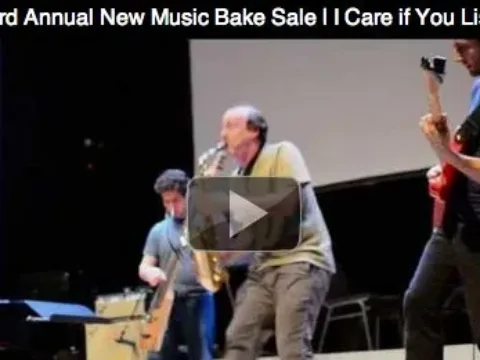
4 Comments »On Sunday, March 11, 2012 the Third Annual New Music Bake Sale took place at Roulette in Brooklyn: great music, nice people, and tons of baked goods. We were happy to modestly sponsor the event, and also had a table there. In between two handshakes, we let the camera roll. Here it is…
Embedding is cool. Crediting is really cool.
Video + Editing + French accent: Thomas Deneuville
Opening animation: Daniel Thompson at DTWebart (http://www.dtwebart.com)
© 2012 I Care if You Listen
Posted by Elias Blumm »
1 Comment »
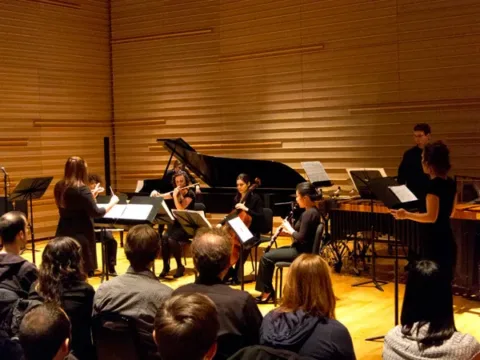
The Norman S. Benzaquen Hall at the DiMenna Center for Classical Music has the appearance of a spruced up practice room, a tall, raw space with instruments piled in the corner. This was no less effective of an environment for Hotel Elefant, a group overflowing with young, dedicated musicians (seventeen in all) who have banded together in order to—as their press kit affirms—interpret the music of “innovative, living composers.” There is something in the collaborative camaraderie within the group, despite its largesse, that speaks to the delight each member takes up in this goal, and in that way the charm of the hall only added to the affect: a bunch of crazy kids lovingly playing a bunch of crazy music, some of it written from within the clique, all of it sounding totally personal in their hands.

Meg Zervoulis conducting Ung’s … still life after death
[Read more →]