Posted by Daniel Emmerson »
Add Comment »
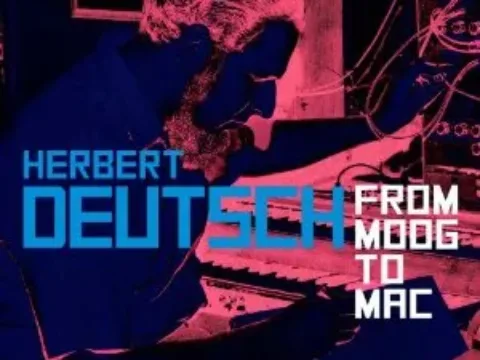
From Moog to Mac sets about curating a documentation of processes, experimentation, and resulting effects that were crafted in the musical alliance between Dr. Herbert Deutsch and Robert Moog after they assembled the world’s first voltage-controlled synthesizer. The album embodies a chronological catalog of instances in development; it formulates segues into the project’s initiation and the advancement of a gadget, which to paraphrase its technical creator, would sound much better when played by someone with more of an imagination. Deutsch turned out to be the man who exemplified just the right amount of artistry, and so, after a single meeting at New York State School Music Association, this great collaboration of minds was instigated and the inquisitive duo set about transforming Moog’s invention into a device that could be played as a musical instrument. These recordings operate as a testament to that partnership through exploring a range of stylistic frameworks. They also keep tabs on the machine’s progressive interaction with people while it accompanies cabaret singers, looped news broadcasts and the opening lines to Shakespeare’s Richard III. The resulting tracks map the synthesizer’s journey across an exciting spectrum of electronic music, which in the case of the Moog synth, began in September 1964.

Robert Moog and Herbert Deutsch
[Read more →]
Posted by Neil Prufer »
Add Comment »
There are many elements of music which we take for granted, especially in traditional Western music, which Hubert Howe does not. These include the even-tempered scale and the concept of standard harmonics. Even the (relative) consistency of instrumental timbre, which is common to almost all music around the world, is eschewed by Mr. Howe in favor of his computer-generated sounds.
This album is part of an ongoing experiment in the outer limits of what can be done with music, walking the line between music and chaos. In Howe’s music, the line is frequently crossed. He created this album entirely using the CSound program (authored by Barry Vercoe). The user of this program can design artificial instruments, as well as override conventional acoustical physics, by selecting the partial overtones created by the notes played.

Hubert Howe
All of these intricate devices combine to create an alien atmosphere of sound. The first piece, Clusters, opens quietly, with what sounds like an organ, then throwing in harp-like glissandi, as the motion moves perpetually upward. There are some traditional devices used, such as the control of consonance and dissonance, and a prolonged call-and-response section. It all builds to an abrupt end.
The second track, Inharmonic Fantasy No. 2, sounds quite similar to the first, but it appears to be a study of vibrato, ranging from flat tones to heavy vibrato. Sometimes you think you can hear bells, and there are some interesting moments with a shimmering quality, but many of the sounds produced are cacophonic and difficult to listen to.
[Read more →]
Posted by George Heathco »
Add Comment »
Phantasm is a collection of eleven recent compositions for saxophone and computer, sourced from a call for scores that spanned the globe and yielded more than two-dozen works. Saxophonist and composer Eric Honour took a chosen ten pieces, plus one of his own, out on the road on an 18-date world tour, and subsequently recorded and released in July of 2011 by Ravello Records. The compositions compiled on Phantasm form a diverse collection of electro-acoustic music that covers a rather large spectrum of styles, textures, and timbres. Honour’s own compositional contribution is the title track. In keeping with the eclectic nature of the entire album, Honour’s “Phantasm” explores a broad pallet, moving between pulse-driven tribal rhythms one moment, to something more amorphic and textural in the next.
Honour’s saxophone performances masterfully navigate a wide variety of pieces, ranging from the precise and rhythmically charged athleticism of Christopher Biggs’ “Exterminate Al the Brutes” and Zachary Crockett’s “Fight to Flow Between,” to the nebulous and free form “Whitewater” by Scott McLaughlin. His playing shows great control and sensitivity on Lou Bunk’s quiet and hushed “Luna, ” while also being able to deliver the right amount of coarseness and brashness for D. Edward Davis’ bluesy and folk-inspired “sugar baby.”
The audio quality is exceptionally high on this album, considering that it is currently offered only as a digital release. Along with the digital download, Ravello Records has an interactive website that accompanies the recording, offering a digital booklet, scores for each of the pieces, ringtones, and a desktop wallpaper. These online extras have many pros, with only a couple of cons. The obvious plus to the Ravello site is that digital recordings often make their way to an mp3 player or to a playlist, where listeners are less likely to engage themselves with the music. The site gives the listener the “old-fashioned” experience of thumbing through a CD booklet while following along with the recording. Also, having the scores readily available are a tremendous help for recordings of electro-acoustic music, where it is often difficult or even impossible to separate the soloist from the electronic element. Such is the case for Karlheinz Essl’s “Sequitur VII” or Luigi Ceccarelli’s “Neuromante,” where Honour sounds as though he is accompanied by several other players.
The only downsides to this particular release, oddly enough, are both the digital booklet and the scores. Not owning a physical copy makes finding out the composer’s names and publication information for each piece a chore, as the only way to find out composer names is to flip through the online booklet. The scores offered on the site have a fairly low resolution, which make following along with the score more of an exercise for testing one’s eyesight than a means for connecting to the musical works.
Overall, this recording and the accompanying website are a great package with exceptional compositions, stellar performances, and a fresh and forward-thinking marketing approach that boad well for digital distribution in the 21st Century.
Eric Honour, Phantasm (Ravello Records, RR7815) – Buy on Amazon.com (digital only)
–
George Heathco is a composer, electric guitarist, collaborator, and teacher that lives in Houston, Tx with his wife and daughter. You can follow him on twitter:@GeorgeHeathco