Posted by Evan Burke »
6 Comments »
Frank Zappa famously asked, “Does humor belong in music?”. He asked this question using an absurdist concert film, and answered it quite profoundly (I’m paraphrasing): of course it does, if music is supposed to be a reflection of human emotional life. Music persists in human society because of its ability to communicate complex emotions directly into our brains, more effectively than spoken or written language. Musicians play their instruments and the music plays us in turn. Humor persists for similar reasons, using language and wordplay and culture to elicit the uniquely human reactions of laughter and amusement. Humor experienced with other people helps you bond, and contributes to your shared history, much like music. But combining them has always been a challenge for composers. Historically, it’s difficult to produce funny instrumental music (although many great musicians have), and even when one hears clever, complex humor in a piece (think Shostakovich’s nervous, bitter sarcasm), it’s not usually laugh-out-loud funny. Finding a piece of instrumental music that you’d guffaw at like an episode of Arrested Development isn’t easy. When there are words, it’s usually in the form of funny lyrics, to a song whose general character is indistinguishable from other, non-funny songs. Nick Zammuto, composer and former ringleader of blues-folk musique-concrete act The Books, has a markedly different approach to music and humor, and together with composer/percussionist Jason Treuting, brought a variety of hilarious pieces to their slice of the Ecstatic Festival.

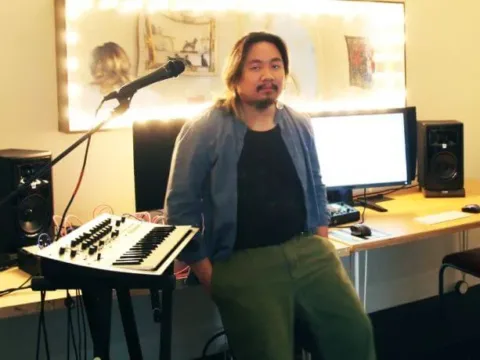
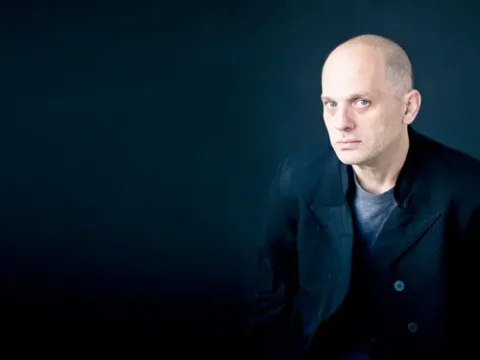
Jason Treuting - Photograph by David Andrako
[Read more →]
Posted by George Heathco »
Add Comment »
Following a fair amount of controversy regarding scandalous album art, Steve Reich released a new album this past September featuring three works: WTC 9/11, performed by the Kronos Quartet; Mallet Quartet, performed by So Percussion; and Dance Patterns, performed by members of Reich’s longtime ensemble Steve Reich and Musicians.
WTC 9/11 is Steve Reich’s third string quartet and, like its predecessors, was composed for the Kronos Quartet. Composed in 2010 the piece bears a striking resemblance to Reich’s first quartet Different Trains in that it features the quartet interacting with prerecorded voices, as well as an element that Reich made use of in his second string quartet Triple Quartet, which is writing for one live quartet and two prerecorded. There are three movements: I. 9/11, II. 2010, III. WTC. It commemorates the 10-year anniversary of the September 11 attacks on New York City, Virginia, and Pennsylvania.

Steve Reich (Source: redbullmusicacademy.com)
[Read more →]
Posted by Jeremy Howard Beck »
1 Comment »
Francisco Goya’s famous series of prints Los Desastres de la Guerra (The Disasters of War) were created between 1810 and 1820, though not actually published until 35 years after Goya’s death, in 1863. There are 82 prints in all, each highly critical of both Spanish and French rulers during the conflicts between the two countries in the early 19th century, and they are shockingly graphic: realistic depictions of mutilated corpses in the aftermath of battle and the effects of famine, and gross mockeries of the ruling classes and the clergy. They are less high art and more a sort of proto-photojournalism.
Martin Bresnick’s Caprichos Enfáticos: Los Desastres de la Guerra, an 8-movement concerto for pianist Lisa Moore and Sō Percussion, begins with, of all things, a farandole/farándula––a popular, jaunty 6/8 chain dance. In live performance, Lisa Moore plays the opening line of the farandúla on xylophone, alone on stage. A percussionist enters behind her and seamlessly takes over the line, and Moore continues to the second line. A second percussionist enters, taking over the first line, and the first percussionist moves to the second line, and Moore moves to the next layer, etc. It’s torturous to try and describe the effect in words, especially since it’s been three years since I saw it live at the 2008 Canberra International Music Festival in Australia, but it really does look and feel like a musical chain dance. It’s also just really cool to watch Lisa Moore play toms.
[Read more →]
Posted by Thomas Deneuville »
5 Comments »
Yesterday night, So Percussion was having a release party for Steven Mackey’s It Is Time (Cantaloupe).

Hosted by AIR (Art International Radio) in lower Manhattan’s historic Clocktower Gallery (how à propos), the show was actually taking place right beneath the clock, in an intimate space featuring a curvy steel and Plexiglas structure. The room was quite packed when the clock stroke 7 and the concert began.

It Is Time is a quadruple percussion concerto written by Steven Mackey, one of the most badass living composers out there. The concerto is divided in 5 movements: Metronome, Steel Drums, Marimba, Drums, and Epilogue, for a total duration of about 40 minutes.
The first movement started with an analog metronome ticking, soon echoed by imitative syncopated rhythms on temple blocks. The high pitched wooden ticks filled the space with a rare sense of urgency as a micro gamelan of small bells entered. The syncopation got wilder and wilder, slowly blurring the pull of the metronome that ended up disappearing. The rigid textural space created in the first movement was followed by a more resonant and metallic one, centered on the steel drums.

Josh Quillen on steel drums
The subjective perception of time really got altered by these lush, free passages on the steel drum and—as if the contrast was not strong enough—the introduction of a microtonal steel drum finished to liquefy the notion of time (the projected video by Mark DeChiazza was then showing drops of white liquid slowly dripping in a white tank). The metronomic pulse reappeared as a Newton’s cradle, but this time it was more perceived as an echo, a consequence, than really a guiding force.
The marimba (played by Adam Sliwinski) entered, for the third movement, and shaped some beautiful echoing waves. The echo was not due to the space itself but written in the score, and one might think that the composer wanted to focus more on the audience’s awareness of the auditory space. From time to space. Seamlessly, the drums emerged and Jason Treuting delivered an incredible fourth movement that was free, controlled, and sometimes outlining a melody on the crotales in the middle of a break. I personally felt that the movement culminated in a sick drums/cowbell duet that would’ve taken Bruce Dickinson’s fever away. From space to time?

Steven Mackey, Jason Treuting and Josh Quillen chilling after the concert
Overall, the piece offers some quiet, introspective, very suggestive moments and infectious grooves flirting with jazz, rock or, as Mackey’s bio states:
vernacular music from a culture that doesn’t actually exist.
The CD comes with a full DVD by Mark DeChiazza which goes beyond a simple video recording of the performance, and adds a layer of interpretation to this already rich piece. Here’s a trailer:
–
Do you have a favorite Mackey piece? Or a So Percussion album? Please, feel free to post a comment or find us on Twitter: @icareifulisten