Posts Tagged ‘Sound Icon’

29
Dec

Two Concerts in Boston: Preservationism or Progressivism? (part 2/2)

Sound Icon | Part 2: The Progressivist (read also Part 1: The Preservationist)

If Boston Musica Viva is the sagacious uncle whose wisdom is centered in the traditions of the past European masters who, despite ushering in the modern era, seem to be something of antiquity, then Sound Icon is the scrappy nephew who looks beyond the insularity of the “new niceness” of American contemporary music toward the primal fierceness of the post modern European avant-garde. The preservationist attitude does not seem to be in the wheelhouse of programming for Sound Icon led by conductor Jeffrey Means (see our interview, Ed.) and executive director Victoria Cheah.  Nearly absent are the ideas of historical reference and reverence  the Les Aventures Spectrales concert highlight this very keenly.

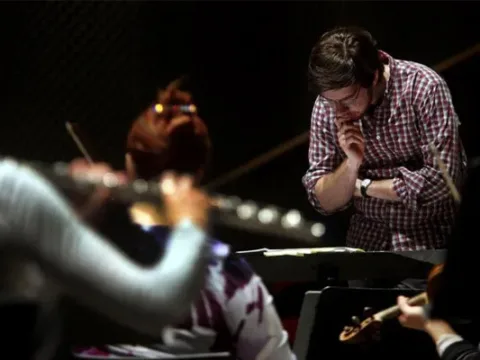
Jeffrey Means conducting Sound Icon (Michele McDonald/Boston-Globe)

Jeffrey Means conducting Sound Icon (Michele McDonald/Boston-Globe)

[Read more →]

28
Dec

Two Concerts in Boston: Preservationism or Progressivism? (part 1 of 2)

Boston Musica Viva | Part 1: The Preservationist

Last November, I began this post with the intention of writing a (double) review of two concerts in the Boston area. In this two part series I comparatively investigate Boston Musica Viva‘s Allusions (November 16) and Sound Icon‘s Les Aventures Spectrales (November 17). This investigation reveals distinct curatorial choices like the presentation of program, musical content, and interaction(s) with audiences. Both concerts, despite their unique differences, maintain similar ritualistic underpinnings of classical art music concert experience. Yet the programming within both concerts reveals two historically omnipresent, albeit distinct, ideals of preservationism and progressivism. Although this dichotomy is not new to “new-music-writ-large,” let alone the music histories with their very core narrative circulating mercurially and gradually between these poles, but given the constant ebb and flow within the concert structure of contemporary music, a moment of self-examination and close reading may be beneficial for performers, composers, critics, and audiences.

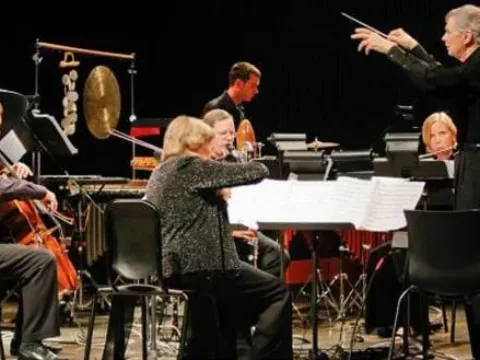
Boston Musica Viva (Photo by Aram Boghostan/Boston Globe)

Boston Musica Viva (Photo by Aram Boghostan/Boston Globe)

[Read more →]

26
Jul

5 questions to Jeffrey Means (Conductor)

Jeffrey Means is not only a founder and the artistic director of the ambitious Sound Icon, he is the man-about-town in the Boston new music scene. Whether he is conducting the Callithumpian Consort, the Firebird Ensemble, the East Coast Contemporary Ensemble, or one of the many concerts put on by academic institutions like Tufts, Brandeis, and NEC, Means, despite only being at this for only five years, has the experience of a seasoned veteran. He has taken his new music clout and channeled it into Sound Icon to not only fill an interesting niche in the Boston new music scene specifically, but also, and more importantly, fill a void in the American landscape of contemporary music ensemble repertoire. Means has an extraordinary vision to usher in the sinfonietta-era of contemporary music in Boston by programming and performing rarely played works, most of which are European. It should be no surprise that the “rarity” of these behomeths is due mostly to the extreme level of difficulty combined with the typically larger (and more expensive) performance forces. Means seems to be nonplussed by this. As Sound Icon prepares for its upcoming second full season they have already taken on mammoth works like Haas’s “in vain” which received spectacular reviews and Rihm’s “Concerto Seraphim.” The sheer gargantuan measure of these works and the stellar performances don’t seem to stack up to the unassuming, affable, and incredibly self-depracating nature of Means. I had the opportunity to sit down with him and discuss his career, especially in regards to his group Sound Icon.

What attracted you to specializing in contemporary music?

It was never a conscious decision, in fact when I was in my masters I only studied, almost exclusively, common-era repertoire. I didn’t actually talk with anyone or study conducting contemporary music intensively until the last few years, and I have been out of school for, what, I think, five years now? In fact when I was in my masters I was pretty much dead set on conducting orchestral repertoire and hopefully including new music, but not only new music. That was my mission for many years. But now I feel that I came to specialize in new music because it’s where I belong, not because it’s a decision I made and then worked to make it happen. I think there was a confluence of purposeful events that caused me to be here doing new music, and I think it’s the right fit for my skill set. The way I rehearse in particular lends itself to new music well. I’m particularly detailed in rehearsals and tend to talk more than most conductors doing works like Beethoven symphonies would need to. In new music I think it is necessary to speak about what’s going on in the piece in rehearsal more than one would with common era repertoire because its generally more complex music and I think everyone needs to be securely on the same page with interpretive elements, like what’s in relief and what isn’t. So, [new music] works out well for me.

Jeffrey Means - Photo by Jesse Weiner

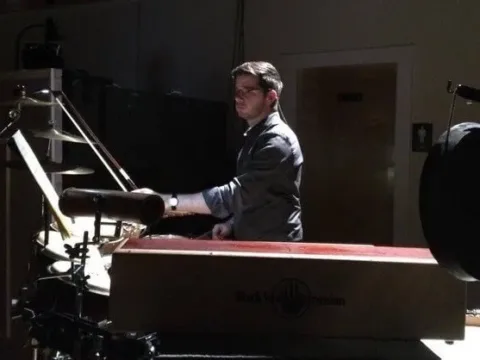
Jeffrey Means – Photo by Jesse Weiner

[Read more →]