Posted by Thomas Deneuville »
Add Comment »According to the band itself,
“Big Farm is a place where serious counterpoint can meet burlesque, earnestness meet abandon; a place where they can kick it or take it to tea, reflect, attack, mourn, dance, pray, or mock with ease or determination, joy or fervor, using any and all means necessary. This world is a big farm – lots of different crops, changing weather, livestock, and a duck pond for good measure.”

Big Farm
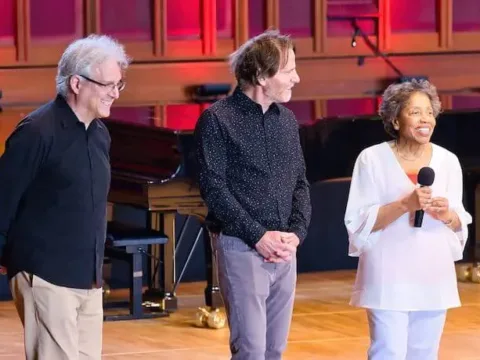
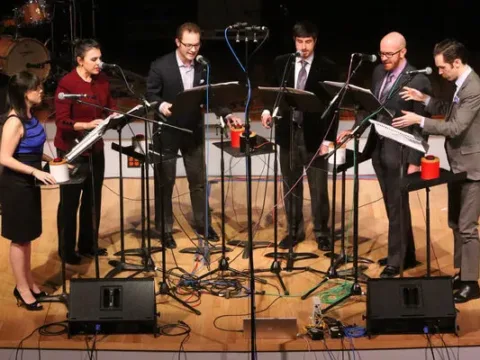
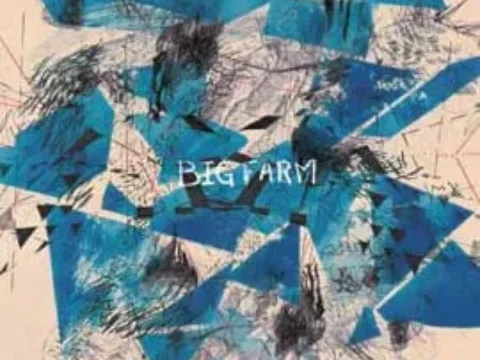
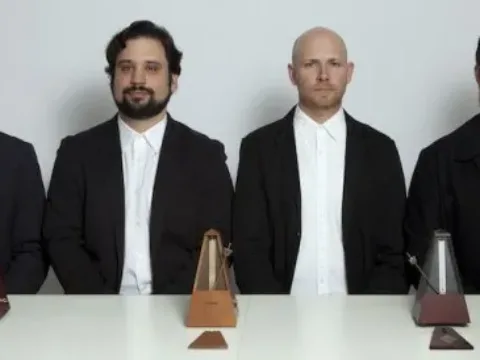
Big Farm is Grammy winner and Pulitzer Prize finalist vocalist-lyricist Rinde Eckert; electric bassist Mark Haanstra; Grammy winner and pioneering composer/guitarist Steven Mackey; and celebrated percussionist Jason Treuting (So Percussion). Thanks to our friends at New Amsterdam Records, we are able to offer an exclusive album preview on I CARE IF YOU LISTEN! The eponymous debut album will be out on May 28, and this preview will stream until May 27, midnight EST.
Let your friends know about it!
Posted by Thomas Deneuville »
Add Comment »On Monday, March 25, the American Modern Ensemble will present American Stories, a program of contemporary works inspired by diverse American stories, by living American composers. We asked 5 questions to Hsin-Yun Huang who will join the AME on the viola to perform pieces by David Ludwig and Steven Mackey.
For two of the pieces recorded on your latest release (Viola, Viola | Bridge records, 2012) you were involved in the commissioning process. How do you choose composers you commission pieces from?
The CD is the brainchild of a project for the last 10 or so years. I started by wanting to commission a composer I admired from my home country Taiwan, so I approached Shih-Hui Chen whom I met while performing with Da Camera in Houston. Steven Mackey is a composer I got to know while in the Borromeo Quartet and was always fascinated by how his “roots” and his language have such personality and are totally unique. Since most of the viola repertoire is on the more serious side, we decided that it would be cool to have a piece that had more of a rock or jazz influence. Then while the recording project was coming together, I thought I needed a simple viola and piano piece to contrast with all the other pieces (they are all of different combination and sonority). The presidents of Bridge Record, David and Becky Starobin introduced Poul Ruders’ music to me. I was immediately taken with his imagination and color. Hence the Romances for Viola and Piano.

Hsin-Yun Huang
[Read more →]
Posted by Sam Reising »
Add Comment »
Atmospheric Shift: Music of the Elements & The Ice:STORM/The Wind:TORNADO | Two Sides Sounding & Zentripetal
TSS teams up with new music duo Zentripetal for series of musical perspectives on the climate extremes experienced globally and seen locally in Brooklyn, as heard through element-inspired chamber music of living composers. Part one of an ongoing project that explores how forces of nature affect individuals every day, from heat and humidity to winds and rain. Music by Eve Beglarian, Gloria Coates, Michael Djupstrom, Daniel Felsenfeld, Lei Liang, Gilda Lyons, and Michael Rose, plus TSS-commissioned works by Kala Pierson and Kamala Sankaram, and a world premiere by Lynn Bechtold.
Monday, March 18 at 8 PM
Tickets $15, $10 students/seniors/artists
South Oxford Space, 138 South Oxford St., Brooklyn, NY
..:: Website
Those Who Do Not Move | Ensemble Sospeso and Moto Perpetuo

Nicholas DeMaison, conductor
These two organizations team up to present the world premiere of Those Who Do Not Move for large ensemble of speaking musicians, live electronics, and dancers by Lewis Nielson. Sharing the program is the US premiere of Simon Bainbridge’s Garden of Earthly Delights for solo mezzo soprano and counter tenor, large ensemble, 8 voice choir, and video.
Tuesday, March 19 at 8 PM
Tickets $15, 10 members/students/seniors
Roulette, 509 Atlantic Ave, Brooklyn, NY
..:: Website
[Read more →]
Posted by Thomas Deneuville »
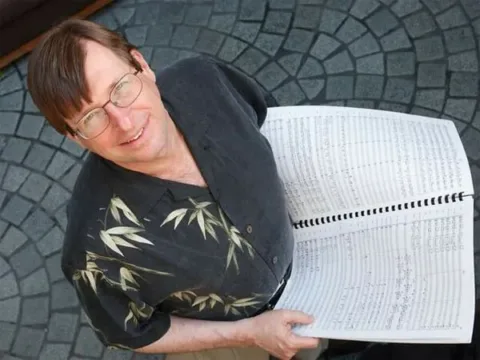
2 Comments »On February 12, the Brentano String Quartet will perform the world premiere of a composition by Steven Mackey at Carnegie Hall. We asked him 5 questions about One Red Rose, written to commemorate the 50th anniversary of the assassination of John F. Kennedy.
The titles of the three movements (1. Five Short Studies, 2. Fugue and Fantasy, 3. Anthem and Aria) are surprisingly generic and formal. Was this dictated by the emotional nature of the subject matter?
Yes, exactly. I wanted the piece to be connected to the assassination but not be dependent on it. The governing metaphors for the work were more abstract than representational. A dominant thread throughout the piece is the exploration of the dialectic between public versus private as manifested in the events of late November 1963. To clarify, I was 7 years old, I was home from school sick in bed, watching TV, when the news broke in. I heard my neighbor burst in the house screaming the news to my mother. They both became transfixed by this international news story while sobbing as if it was their personal loss. Another example is the idea of a state funeral which is a very public event governed by strict protocols. The members of the family are in some sense performing the rite for the sake of a broader public and for that performance a certain dignity and stoicism is assumed. Yet, their own deep loss and personal grief has to be dealt with at some point. The third movement – Anthem and Aria – embodies that dialectic quite clearly: an Anthem is typically a musical expression of public feelings like patriotism, devotion, etc. while an Aria is the place in an opera where an individual character expresses personal emotion.
Another thread connecting the piece to the assassination is the simultaneous chaos and control on many different levels. I see this as being related to the idea of public and private or group versus individual. The swirling chaos of a manhunt and the meticulous, microscopic examination of the 6th floor of the book depository for clues. A frenzied race to the hospital while Jackie Kennedy immovably comforts her husband. Fugue and Fantasy embodies this kind of contrast in that a fugue is very a highly structured musical form but, in this case, it’s expressive character is wild, even chaotic.

Steven Mackey
[Read more →]
Posted by George Heathco »
1 Comment »
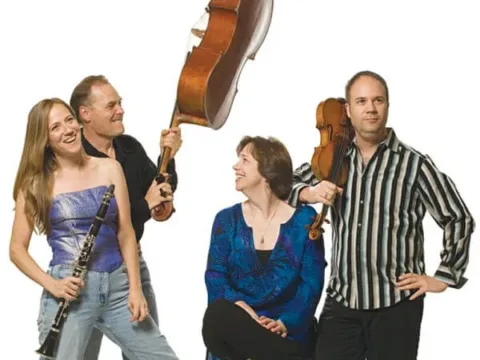
There were two wonderful opportunities over the past month for chamber music fans in Texas to experience fantastic performances of master works by leading contemporary American composers. The pair of concerts were on May 8 and 9 in San Antonio, and were presented by veteran new music group SOLI Chamber Ensemble. SOLI is a contemporary music quartet based in San Antonio, Texas, and is comprised of clarinetist Stephanie Key, violinist Ertan Torgul, cellist David Mollenauer, and pianist Carolyn True. They presented a youthful, energetic, and bold program of five works on May 8 at Trinity University’s Ruth Taylor Recital Hall. The program was repeated the following night at the McNay Art Museum, in the Leeper Auditorium. Of the five works performed over the two evenings, two pieces were premiere performances of specific arrangements, and one was a world premiere of a brand new collaborative work by composer Steven Mackey and video artist Mark DeChiazza.

SOLI Chamber Ensemble
[Read more →]
Posted by Thomas Deneuville »
6 Comments »Yesterday night, So Percussion was having a release party for Steven Mackey’s It Is Time (Cantaloupe).

Hosted by AIR (Art International Radio) in lower Manhattan’s historic Clocktower Gallery (how à propos), the show was actually taking place right beneath the clock, in an intimate space featuring a curvy steel and Plexiglas structure. The room was quite packed when the clock stroke 7 and the concert began.

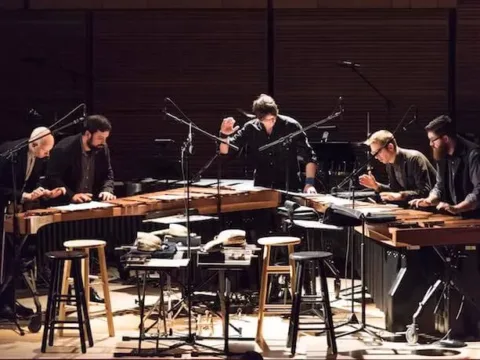
It Is Time is a quadruple percussion concerto written by Steven Mackey, one of the most badass living composers out there. The concerto is divided in 5 movements: Metronome, Steel Drums, Marimba, Drums, and Epilogue, for a total duration of about 40 minutes.
The first movement started with an analog metronome ticking, soon echoed by imitative syncopated rhythms on temple blocks. The high pitched wooden ticks filled the space with a rare sense of urgency as a micro gamelan of small bells entered. The syncopation got wilder and wilder, slowly blurring the pull of the metronome that ended up disappearing. The rigid textural space created in the first movement was followed by a more resonant and metallic one, centered on the steel drums.

Josh Quillen on steel drums
The subjective perception of time really got altered by these lush, free passages on the steel drum and—as if the contrast was not strong enough—the introduction of a microtonal steel drum finished to liquefy the notion of time (the projected video by Mark DeChiazza was then showing drops of white liquid slowly dripping in a white tank). The metronomic pulse reappeared as a Newton’s cradle, but this time it was more perceived as an echo, a consequence, than really a guiding force.
The marimba (played by Adam Sliwinski) entered, for the third movement, and shaped some beautiful echoing waves. The echo was not due to the space itself but written in the score, and one might think that the composer wanted to focus more on the audience’s awareness of the auditory space. From time to space. Seamlessly, the drums emerged and Jason Treuting delivered an incredible fourth movement that was free, controlled, and sometimes outlining a melody on the crotales in the middle of a break. I personally felt that the movement culminated in a sick drums/cowbell duet that would’ve taken Bruce Dickinson’s fever away. From space to time?

Steven Mackey, Jason Treuting and Josh Quillen chilling after the concert
Overall, the piece offers some quiet, introspective, very suggestive moments and infectious grooves flirting with jazz, rock or, as Mackey’s bio states:
vernacular music from a culture that doesn’t actually exist.
The CD comes with a full DVD by Mark DeChiazza which goes beyond a simple video recording of the performance, and adds a layer of interpretation to this already rich piece. Here’s a trailer:
–
Do you have a favorite Mackey piece? Or a So Percussion album? Please, feel free to post a comment or find us on Twitter: @icareifulisten