Posts Tagged ‘Thomas Adès’

22
May

Chicago New Music Label Parlour Tapes+ Makes a Killing

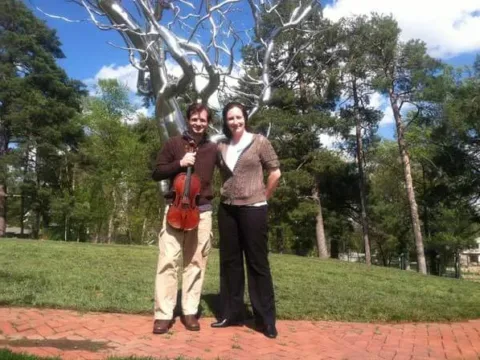
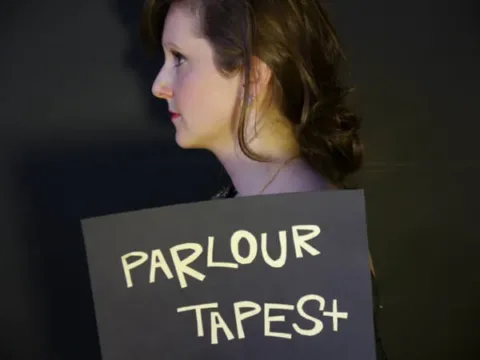
PTplus-Logo-250wJust like Jay Gatsby (the literary version, not the current Luhrmann fiasco), Chicago’s new music scene is something of a mystery to the rest of the world. And yet, according to Andrew Tham, one of Chicago’s most passionate new music entrepreneurs (and an ICIYL contributing editor), “it’s something that everyone’s been talking about.” Tham is a tall, lanky man in his 20s, and he’s dressed in a black lace dress with a shawl covering his forehead, like Lorca’s Bernarda Alba with a sunny disposition. His theatricality doesn’t stand out, however, in view of the evening’s other spectacles. On Thursday, May 16, 2013,  in Chicago’s Logan Square, four young new music enthusiasts presented The Guilty Party, a murder mystery event cum concert announcing the arrival of their joint ambition: Parlour Tapes+, the Midwest’s newest new music label, and perhaps the first of its kind. (Ed.: for more background, read our recent 5 Questions to… interview.)

Composer, soprano, and Parlour Tapes+ co-founder Jenna Lyle (photo credit: parlourtapes.com)

Composer, soprano, and Parlour Tapes+ co-founder Jenna Lyle (photo credit: parlourtapes.com)

[Read more →]

6
May

This week: concerts in New York (May 6 – May 12, 2013)

Brooklyn Youth Chorus & Kronos Quartet

Brooklyn Youth Chorus - Photo by Joshua Simpson

Brooklyn Youth Chorus – Photo by Joshua Simpson

Enjoy cocktails and light supper at the stylish Green Building followed by a performance featuring BYC with Kronos Quartet at Roulette. The evening honors longtime board member Hillary Richard. The program presents BYC commissions, including a world-premiere by Julia Wolfe and works by Shara Worden (My Brightest Diamond). New York premieres by Aleksandra Vrebalov and Richard Reed Parry (Arcade Fire), and works by Bryce Dessner (The National, Clogs) are also featured as part of a new series of BYC co-commissions with BAM.
Tuesday, May 7 at 8 PM
Tickets $45
Roulette, 509 Atlantic Avenue, Brooklyn, NY
..:: Website

Acqua Alta (High Water) | Jenny Q Chai

Jenny Q Chai

Jenny Q Chai

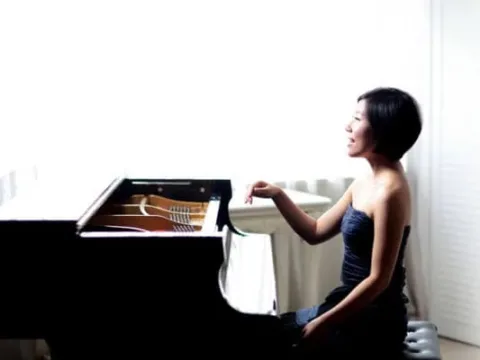
Acqua Alta (High Water) will be the anchor of a month-long programming focus on global warming at Spectrum, with sound and video installations based on data curated by Ian Fenty, whose doctoral dissertation at MIT addressed ’s new studied of global warming and its effects on our oceans. John Cage’s athletic Water Walk (see schematic attached/above) is the centerpiece of the program. Written in 1959, John Cage’s Water Walk is scored for a number of objects, including bathtub, rubber duck, prepared piano and five radios. It was originally premiered on the Italian TV show Lascia O Raddoppia. Ninnananna from Marco Stroppa’s Miniature Estrose—a lullaby in which its out of worldly tremors creates a gentle watery shimmer and explores the two relations between two states of mind, with initiated knowledge one might trace hidden lullabies by Brahms, Schubert, Stravinsky and an Italian lullaby Stroppa’s mother used to sing to him. Scarlatti and Gibbons provides the sensation of traveling back in time in Italy, while Debussy and Ravel adds their watery imagery. Three world premieres by Nils Vigeland, Milica Paranosic and Michael Vincent Waller reflect contemporary composers’ take on global warming. To complete the experience, the stage and the hall are transformed with projections of Italian Renaissance paintings, which stunningly portray the luminous beauty of Italy.
Tuesday, May 7 at 8 PM
Tickets $15, $10 students/seniors
Spectrum, 121 Ludlow St., 2nd floor, New York, NY
..:: Website
[Read more →]

8
Mar

newEar Ensemble’s “Strangely Familiar” in Kansas City

allsouls logo 250 wideKansas City’s major classical music ensembles have focused on melding visual and musical art for the 2012-2013 season. The Kansas City Ballet collaborated with the Kansas City Symphony and Chorus to stage Orff’s Carmina Burana last fall. In February, the Symphony premiered a work by Adam Schoenberg titled Picture Studies, a 21st century Pictures at an Exhibition inspired by works displayed at the local Nelson-Atkins Museum of Art. It was the newEar Contemporary Music Ensemble‘s turn on March 1-2, 2013, to explore musical, visual, and also literary connections with a concert titled “Strangely Familiar.”

Kansas City's newEar Contemporary Music Ensemble

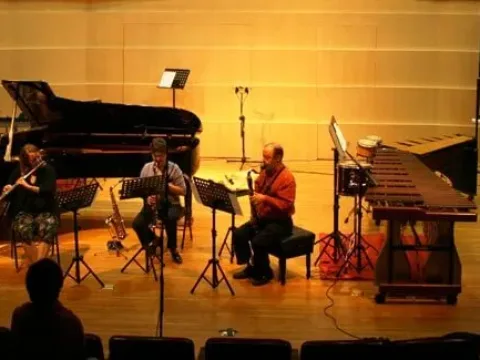
Kansas City’s newEar Contemporary Music Ensemble (photo credit: newear.org)

[Read more →]

10
Jan

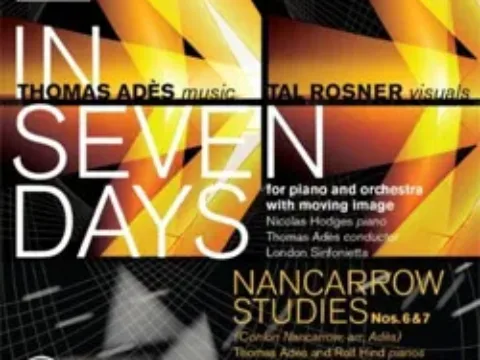
Thomas Adès: In Seven Days (London Sinfonietta/Signum Records)

A fascinating new release from Signum Classics, and the second with the London Sinfonietta, is In Seven Days by the British composer Thomas Adès (b. 1971), alongside arrangements by Adès of two Nancarrow studies for two pianos.  In Seven Days is a work for piano and orchestra with moving image (created by Tal Rosner) and was jointly commissioned by the Southbank Centre and the Los Angeles Philharmonic and first performed in 2008. It tells the story of creation but returns to the Hebrew version and it is certainly compelling to hear the composer and creator of the visuals Rosner discuss the work in conversation on the DVD, along with performances of the works with the visuals.

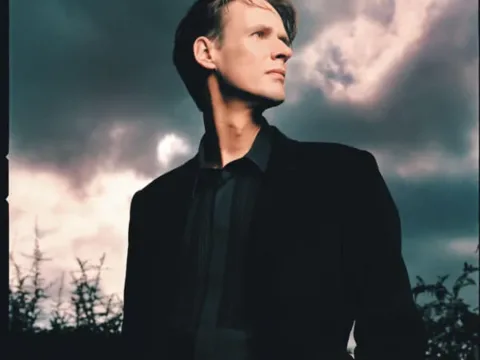
Thomas Adès – Photo by Maurice Foxall

[Read more →]

5
Dec

Ian Bostridge and Thomas Adès at Carnegie Hall: Dusting off Romanticism

What happens when a brilliant Lied performer is accompanied by a foremost composer? Well, something unique. Last Monday, Ian Bostridge and Thomas Adès were giving a joint recital at Carnegie that felt like a 21st century Schubertiade.

The first half spanned over four centuries and was entirely performed attacca, placing the Dichterliebe (the pièce de résistance of the evening) in an aesthetic and emotional pan-European continuum. The evening started with In darkness let me dwell, an English song by John Downland. Although usually accompanied by a lute, this lament kept its sense of intimacy and introspection intact thanks to Adès’s sensible piano accompaniment. Bostridge’s clear and velvety timbre fits this repertoire (often performed by countertenors) perfectly with more colors than the usual straight tone.

Ian Bostridge – Photo by Simon Fowler

The piece was immediately followed by Darkness Visible, Adès’s personal take on Dowland’s song. Written for solo piano, Darknesse Visible is a both a precise exploration of the melodic and harmonic DNA of the song, and a complete implosion. Shimmering inner voices are surrounded by bell-like sonorities on both extremes of the piano range. The exciting idea behind Darknesse Visible is that, according to the composer, “no notes have been added”, although some have been removed…

Bostridge came back to the front of the stage to perform Hörderlin: Ann… a song by Gÿorgy Kurtág on poetry by Johann Friedrich Holderlin (a contemporary of Heine)—an angular link in the chain that tied all the pieces of the first half. The piece bended even further the notion of time in this kaleidoscopic first half by using Romantic poetry set to sprechstimme.

Finally, the bitter sweet arpeggios of Im wunderschönen Monat Mai from Schumann’s Dichterliebe were heard and Bostridge proved, once again, that he is one of the best Lied performers on the international stage. The program notes for the evening reminded the audience that, for Schumann, the pianist was almost acting as a catalyst for the singer’s emotions. In Adès’s case, though, one could almost wonder if the situation was not out of balance. Indeed, on many songs, tempi were surprisingly slow like in this dragging Ich grolle nicht or incredibly fast (Die Rose, die Lilie). Adès’s take on dynamics was also very personal, and the piano was generally very quiet, even on the massive Im Rhein.

Thomas Adès – Photo by Maurice Foxall

The second half, although more traditional and deeply rooted in Romanticism, featured some gems. Adès opened with a brilliant interpretation of  Petrarch Sonnet No. 123, from Liszt’s Années de pèlerinage, a perfect introduction to three rarely (Schade!) performed Liszt songs: Es muss ein Wunderbares sein, Im Rhein, in schönen Strome and Ihr Glocken von Marling. The fact that one of the songs was set on the same Heine text that Schumann used in his Dichterliebe provided an interesting perspective on the two composers’s interpretations of the poetry. Indeed, Liszt’s Im Rhein… focused more on the liquid element and less on the majesty of the Rhine. The program was closed by a selection of six songs from Schubert’s Schwanengesang.

Beyond the first-class musicianship of both Bostridge and Adès, the clever and organic inclusion of pieces from different eras (in the first half only) was really one of the strongest points of this program and one could wish that more classical concerts were curated this way.

Thomas Deneuville, the founder and editor of I care if you listen, is a French-born composer living in NY. Find him on Twitter: @tonalfreak